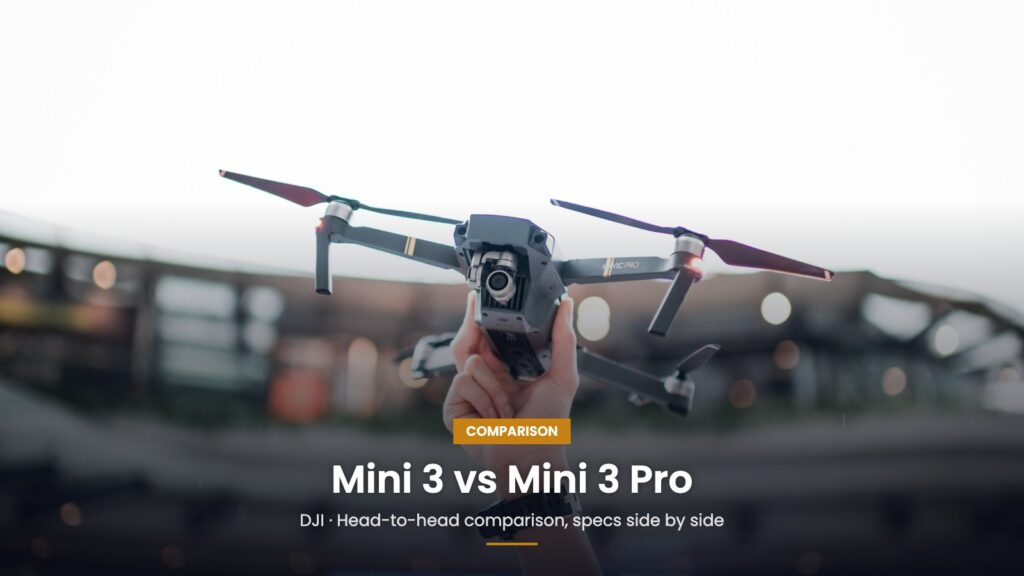
DJI Mini 3 vs DJI Mini 3 Pro
The DJI Mini 3 Pro wins this comparison because it adds the three things the Mini 3 leaves out: obstacle sensing, subject tracking and a stronger video pipeline. Both drones share a 1/1.3-inch 48 MP sensor with an f/1.7 lens...
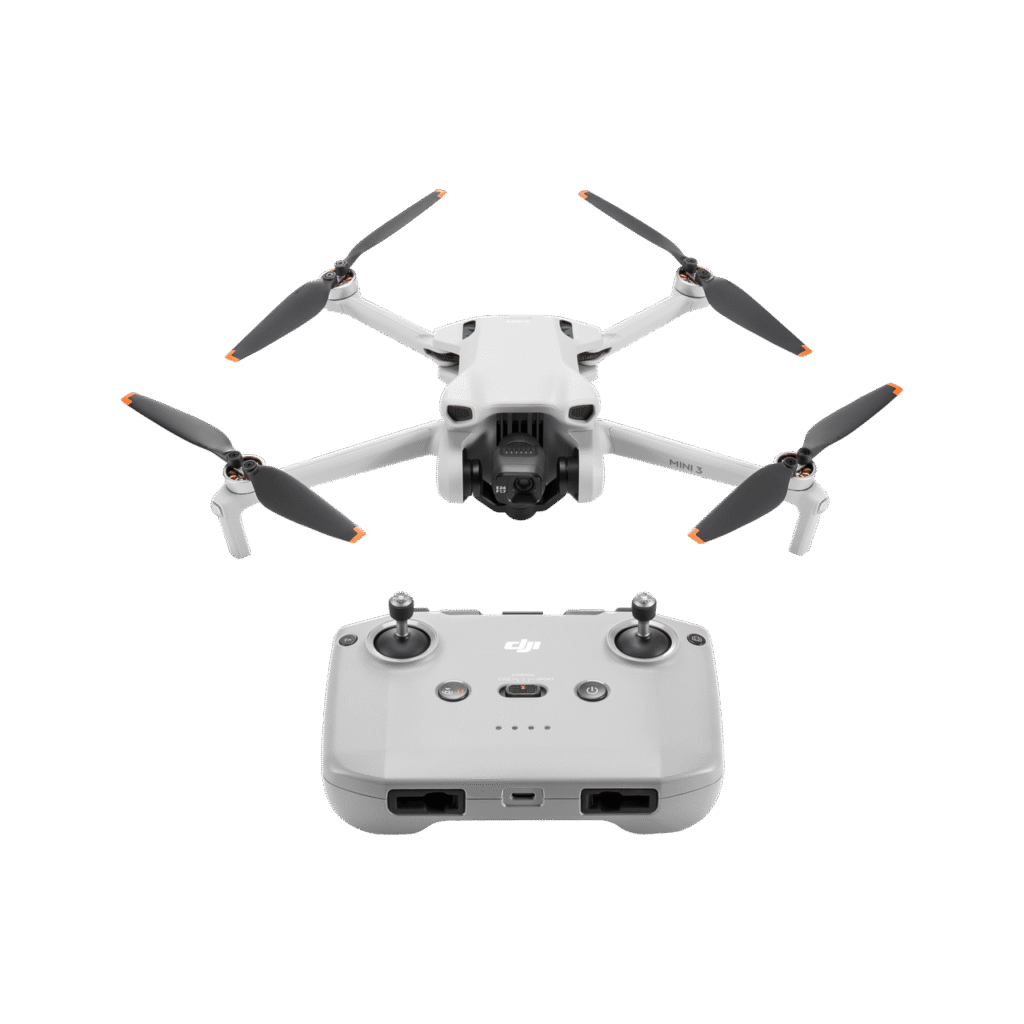
DJI Mini 3
Launched at $469 (aircraft only, 2022)
Performance Breakdown
DJI Mini 3
add_circle PROS
- 38-minute standard flight time beats the Mini 3 Pro by 4 minutes
- Same 1/1.3-inch 48 MP sensor size and f/1.7 lens as the Pro
- True Vertical Shooting rotates the camera for full-sensor portrait framing
- Plus battery raises rated endurance to 51 minutes
- Launched $200 cheaper than the Mini 3 Pro aircraft
remove_circle CONS
- No forward or backward obstacle sensing
- No ActiveTrack or FocusTrack subject tracking
- 4K tops out at 30fps with a 100 Mbps bitrate
- Older O2 transmission with a 720p live view
- Normal color profile only; no D-Cinelike
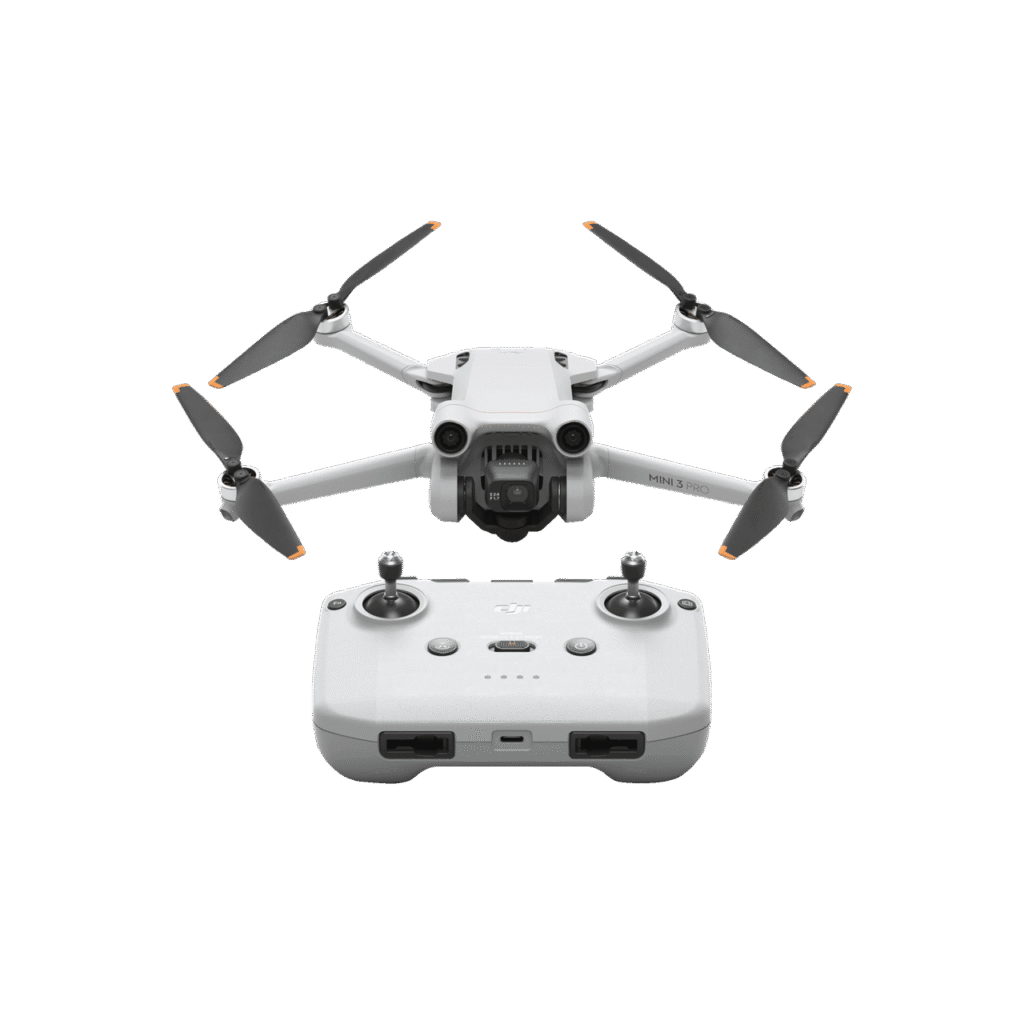
DJI Mini 3 Pro
add_circle PROS
- FocusTrack suite with ActiveTrack 4.0, Spotlight 2.0 and POI 3.0
- Forward, backward and downward obstacle sensing
- 4K/60fps and FHD/120fps slow motion at up to 150 Mbps
- D-Cinelike color profile for more grading latitude
- O3 transmission reaches 12 km FCC with a 1080p/30fps live view
remove_circle CONS
- 34-minute standard flight time is shorter than the Mini 3
- No lateral or upward obstacle sensing
- Higher launch price for the same sensor size
- No internal storage; microSD required
- Color depth is 8-bit; no D-Log M or HLG
Mini 3 or Mini 3 Pro: Which One Should You Buy?
The DJI Mini 3 Pro wins this comparison because it adds the three things the Mini 3 leaves out: obstacle sensing, subject tracking and a stronger video pipeline. Both drones share a 1/1.3-inch 48 MP sensor with an f/1.7 lens and both support True Vertical Shooting, so still-image quality at base ISO is closer than the price gap suggests. The difference shows up in motion. The Mini 3 Pro records 4K at up to 60fps and FHD at 120fps with a 150 Mbps bitrate and D-Cinelike, while the Mini 3 stops at 4K/30fps and 100 Mbps in Normal color. The Pro also carries forward and backward vision sensors and the FocusTrack suite, which makes solo filming far safer and easier. The Mini 3 fights back on endurance and price: its standard battery is rated for 38 minutes against 34 minutes for the Pro, and it launched $200 cheaper. Choose the Mini 3 if you fly manually in open spaces and mainly shoot stills or 30fps travel clips; choose the Mini 3 Pro if you film yourself, fly near trees or buildings, or edit in a flat color profile.
Check DJI Mini 3 Pro price on Amazon →Affiliate link. We may earn a commission at no extra cost to you.

Alihan Demirdaş is the founder and editor of Drone Ranker. A software developer by profession, he researches drones the way he reads code: from the primary documents. Every review, comparison and news story on the site is written by him from manufacturer specification sheets, FCC and EU certification filings, aviation-authority rules and dated press releases, with the source linked. Unless a page is labelled hands-on, the analysis is documentary; when an aircraft is in his hands, the page says so and carries his own photographs and flight notes. He covers consumer, professional and agricultural drones and is based in Türkiye.
Technical Specifications
Last updated: Oct 2026| Feature | DJI Mini 3 | DJI Mini 3 Pro |
|---|---|---|
| Weight | 248 g with standard battery; approx. 290 g with Intelligent Flight Battery Plus | Under 249 g with standard battery; approx. 290 g with Intelligent Flight Battery Plus |
| Dimensions | 148×90×62 mm folded; 251×362×72 mm unfolded with propellers | 145×90×62 mm folded; 171×245×62 mm unfolded without propellers stars |
| Volume | Approx. 826 cm³ folded bounding-box volume | Approx. 809 cm³ folded bounding-box volume stars |
| Max Speed | 16 m/s (manufacturer-stated) | 16 m/s in Sport mode (manufacturer-stated) |
| Max Flight Distance | 18 km standard; 25 km Plus (manufacturer-stated) | 18 km standard; 25 km Plus (manufacturer-stated) |
| Sensor Size | 1/1.3-inch CMOS, dual native ISO | 1/1.3-inch CMOS, dual native ISO |
| Megapixels | 48 MP | 48 MP |
| Max ISO | ISO 100-3,200 (video and photo) | ISO 100-6,400 (video and photo) stars |
| Flight Time | 38 minutes standard; 51 minutes Plus (manufacturer-stated) stars | 34 minutes standard; 47 minutes Plus (manufacturer-stated) |
| Max Resolution | 4K/30fps; 2.7K and FHD up to 60fps; HDR video at 24/25/30fps | 4K up to 60fps; FHD/120fps slow motion; HDR video at 24/25/30fps stars |
| Movie Bitrate | 100 Mbps (H.264) | 150 Mbps (H.264/H.265) stars |
| Field of View | 82.1° | 82.1° |
| Transmission Range | DJI O2: 10 km FCC; 6 km CE/SRRC/MIC | DJI O3: 12 km FCC; 8 km CE/SRRC/MIC stars |
| Wind Resistance | 10.7 m/s (Level 5) | 10.7 m/s (Level 5) |
| Obstacle Avoidance | Downward vision positioning only; no forward, rear, lateral or upward obstacle sensing | Tri-directional vision sensing: forward, backward and downward; no lateral or upward sensing stars |
| Battery Power | 2453 mAh, 18.1 Wh standard; 3850 mAh, 28.4 Wh Plus | 2453 mAh, 18.1 Wh standard; 3850 mAh, 28.4 Wh Plus |
| Charge Time | Standard: approx. 64 min in aircraft or 56 min in charging hub; Plus: approx. 101 min or 78 min (30W charger) | Standard: approx. 64 min in aircraft or 56 min in charging hub; Plus: approx. 101 min or 78 min (30W charger) |
| Internal Storage | None; microSD card required | None; microSD card required |
| GPS | Yes, GPS + GLONASS + Galileo | Yes, GPS + Galileo + BeiDou |
| Obstacle Detection | No; downward positioning sensors only | Yes, forward, backward and downward stars |
| Return to Home | Yes | Yes |
| Removable Battery | Yes | Yes |
| Shoots RAW | Yes, JPEG and DNG RAW | Yes, JPEG and DNG RAW |
| HDR Mode | Yes, HDR video at 24/25/30fps and HDR photos | Yes, HDR video at 24/25/30fps and HDR photos |
| Weather Sealed | No official IP rating | No official IP rating |
| Best For | Budget-minded travel photographers who value flight time over tracking and obstacle sensing | Solo creators who need subject tracking, 4K/60fps and forward/backward obstacle sensing |
| Subject Tracking | None (QuickShots only) | FocusTrack: ActiveTrack 4.0, Spotlight 2.0, POI 3.0 stars |
| Color Profiles | Normal only | Normal and D-Cinelike (8-bit) stars |
| Slow Motion | None listed (FHD up to 60fps) | FHD/120fps stars |
| Live View Quality | 720p/30fps (O2) | 1080p/30fps (O3) stars |
| Plus Battery Flight Time | 51 minutes stars | 47 minutes |
| Launch Price (aircraft only) | $469 stars | $669 |
DJI Mini 3 vs Mini 3 Pro in One Minute
The Mini 3 Pro arrived first, in May 2022, as the creator model. The Mini 3 followed in December 2022 as a simplified version of the same airframe idea. DJI kept the 1/1.3-inch sensor and True Vertical Shooting, then removed the parts that cost the most: obstacle sensors, ActiveTrack, the O3 radio and the higher-bitrate video modes. In exchange the Mini 3 gained 4 minutes of rated flight time.
Key differences at a glance
- Obstacle sensing: none on the Mini 3; forward, backward and downward on the Mini 3 Pro.
- Tracking: none on the Mini 3; ActiveTrack 4.0, Spotlight 2.0 and POI 3.0 on the Mini 3 Pro.
- Video: 4K/30fps at 100 Mbps versus 4K/60fps at 150 Mbps plus FHD/120fps slow motion.
- Transmission: O2 at 10 km FCC versus O3 at 12 km FCC.
- Battery: 38 minutes versus 34 minutes with the standard pack.
- Same sensor size, same lens aperture, same True Vertical Shooting.
Camera and Video: Same Sensor, Different Pipeline
Because both drones use a 1/1.3-inch sensor behind an f/1.7 lens, a photo taken at base ISO in good light will look very similar from either aircraft. Both save DNG RAW files, so photographers who shoot landscapes and edit afterwards lose little by choosing the Mini 3.
Video is where the Pro earns its price. It records 4K up to 60fps at 150 Mbps, offers FHD at 120fps for slow motion and adds the D-Cinelike flat profile. The Mini 3 records 4K only up to 30fps at 100 Mbps in Normal color. For smooth pans, fast subjects or footage you plan to color grade, the Mini 3 Pro gives far more room to work.
Safety: Obstacle Sensing and Tracking
The Mini 3 relies on the pilot for every obstacle. It uses its downward sensors only for positioning and landing, so flying backwards toward a tree during a reveal shot is entirely your responsibility. The Mini 3 Pro can see forward and backward and will brake or bypass obstacles in supported modes. It still cannot see to the sides or above, so lateral flight near branches requires care on both drones.
Tracking follows the same pattern. The Mini 3 Pro can lock onto a runner, cyclist or car with ActiveTrack 4.0 and keep it framed while you concentrate on the shot. The Mini 3 offers only preset QuickShots, which are useful for short social clips but cannot follow a moving subject.
Flight Time and Range
The Mini 3 is the endurance winner: 38 minutes with the standard battery and 51 minutes with the Plus battery, compared with 34 and 47 minutes on the Mini 3 Pro. Real flights end earlier because of wind, temperature and the reserve you keep for landing, but the 4-minute gap holds across both packs.
For range, the Mini 3 Pro uses DJI O3 with up to 12 km FCC and a 1080p live view, while the Mini 3 uses O2 with 10 km FCC and a 720p feed. The sharper live view matters more day to day than the maximum distance, because it helps you judge focus and framing on the controller.
Who Should Buy Which?
Buyer scenarios
- Landscape and travel photographer on a budget: DJI Mini 3.
- Solo vlogger or athlete filming yourself: DJI Mini 3 Pro.
- Flying near trees, cliffs or buildings: DJI Mini 3 Pro.
- Longest flight time per battery: DJI Mini 3.
- Color grading in a flat profile: DJI Mini 3 Pro.
- Vertical social video: either drone.
Both models are now older designs, and DJI lists software support for the Mini 3 through the end of 2026. Buyers who want omnidirectional sensing and 10-bit color should also look at the newer Mini 4 Pro or Mini 5 Pro. Between these two, the Mini 3 Pro is the more complete drone and the Mini 3 is the better-value flying camera.
Why Trust Drone Ranker?
Related Drone Guides & Reviews
Context, limitations, and sources
Mini 3 and Mini 3 Pro share a 1/1.3-inch sensor, so the decision is about motion: tracking, obstacle sensing and 4K/60fps favor the Pro, while flight time and price favor the Mini 3.
Limitations
Specification-based comparison; no hands-on flight test. Prices are launch prices and used-market prices vary. Plus battery raises both aircraft to about 290 g, which changes registration rules in many jurisdictions. DJI Mini 3 Pro data comes from the DJI support page because the original spec page now redirects.