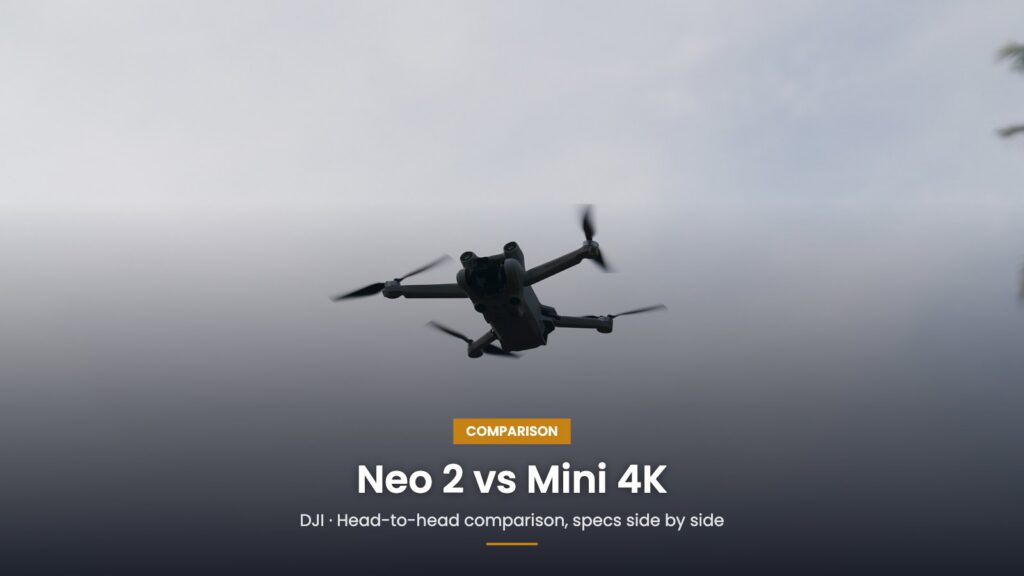
DJI Neo 2 vs DJI Mini 4K
Get the DJI Neo 2 if you want a drone that films you: it tracks subjects, launches from your palm, has guarded propellers and omnidirectional sensing, and weighs just 151 g. Get the DJI Mini 4K if you want a conventional camera drone that flies…
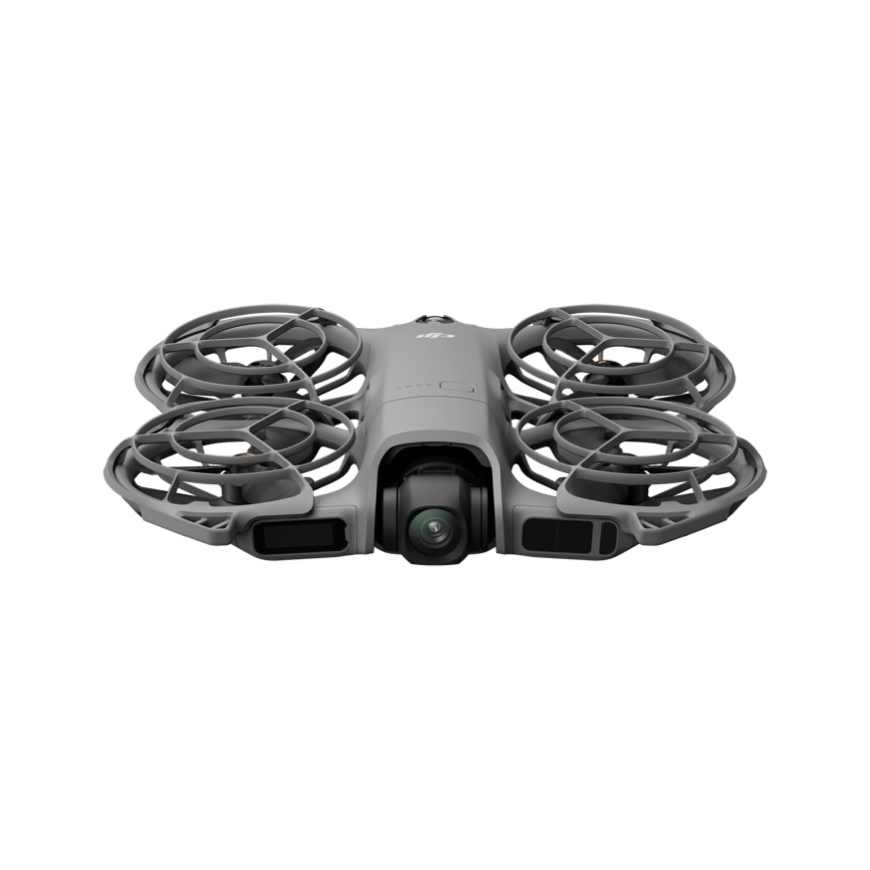
DJI Neo 2
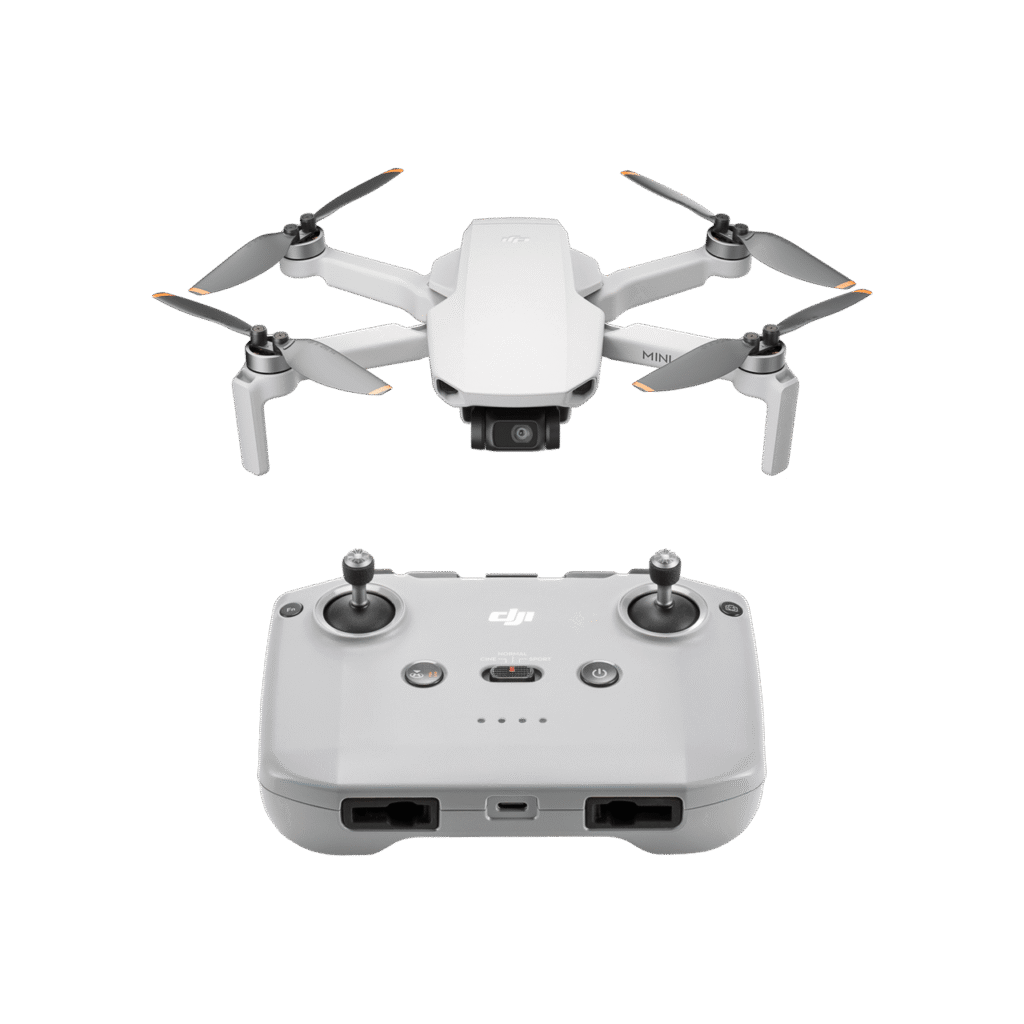
DJI Mini 4K
Technical Specifications
Last updated: Oct 2026| Feature | DJI Neo 2 | DJI Mini 4K |
|---|---|---|
| Weight | 151 g without digital transceiver; 160 g with digital transceiver | 246 g with standard battery |
| Dimensions | 147×171×41 mm without digital transceiver; 167×171×54 mm with transceiver | 138×81×58 mm folded |
| Volume | Approx. 1031 cm³ without digital transceiver | Approx. 648 cm³ folded bounding-box volume |
| Max Speed | 12 m/s in Sport mode and tracking (manufacturer-stated) | 16 m/s in Sport mode (manufacturer-stated) |
| Max Flight Distance | 7 km (manufacturer-stated) | 15.7 km (manufacturer-stated) |
| Sensor Size | 1/2-inch CMOS | 1/2.3-inch CMOS |
| Megapixels | 12 MP | 12 MP |
| Max ISO | ISO 12,800 for video and supported photo modes | ISO 3,200 |
| Flight Time | Approx. 19 minutes; approximately 17 minutes with propeller guards | 31 minutes (manufacturer-stated) |
| Max Resolution | 4K up to 60fps; 4K/100fps slow motion; 2.7K vertical up to 60fps | 4K up to 30fps; 2.7K up to 60fps |
| Movie Bitrate | 80 Mbps | 100 Mbps |
| Field of View | 119.8° | 83° |
| Transmission Range | Wi-Fi: 500 m; optional O4: 10 km FCC and 6 km CE/SRRC/MIC | 10 km FCC; 6 km CE/SRRC/MIC |
| Wind Resistance | 10.7 m/s (Level 5) | 10.7 m/s (Level 5) |
| Obstacle Avoidance | Omnidirectional monocular vision with forward LiDAR and downward infrared sensing | Downward vision positioning only; no directional obstacle avoidance |
| Battery Power | 1606 mAh, 11.5 Wh | 2250 mAh, 17.32 Wh |
| Charge Time | Approx. 70 minutes in aircraft; hub can charge three batteries in approximately 68 minutes with sufficient power | Not specified on the referenced DJI specification page |
| Internal Storage | 49 GB; no microSD expansion | None; microSD card required |
| GPS | Yes, GPS + Galileo + BeiDou | Yes, GPS + GLONASS + Galileo |
| Obstacle Detection | Yes, omnidirectional vision with forward LiDAR and downward infrared sensing | No dedicated obstacle detection; downward positioning sensors only |
| Return to Home | Yes, with a compatible remote-control and transmission setup | Yes |
| Removable Battery | Yes | Yes |
| Shoots RAW | No, JPEG photos only | Yes, DNG |
| HDR Mode | No dedicated HDR mode listed | No dedicated HDR mode |
| Weather Sealed | No official IP rating | No official IP rating |
| Best For | Vloggers and solo creators who want automated tracking shots | Budget buyers who want flight time, RAW photos and stable footage |
| Gimbal Stabilization | 2-axis mechanical gimbal: tilt and roll | 3-axis mechanical gimbal: tilt, roll and pan |
| Maximum 4K Frame Rate | 4K/100fps slow motion; 4K/60fps standard recording | 4K/30fps |
| Vertical Video | 2.7K vertical up to 60fps | No dedicated vertical mode |
| Photo Format | JPEG | JPEG and DNG RAW |
| Camera Aperture | f/2.2 | f/2.8 |
| Internal Storage | 49 GB | None |
| External Storage | No microSD expansion | microSD card required |
| Standard Video Transmission | Wi-Fi up to 500 m under FCC conditions | DJI O2 up to 10 km under FCC conditions |
| Optional Video Transmission | DJI O4 up to 10 km FCC with digital transceiver | No optional transmission upgrade |
| Maximum FCC Transmission Range | 10 km with optional O4 setup | 10 km with O2 |
| Maximum CE Transmission Range | 6 km with optional O4 setup | 6 km with O2 |
| Manufacturer-Stated Flight Time | Approx. 19 minutes; approximately 17 minutes with propeller guards | 31 minutes |
| Manufacturer-Stated Flight Distance | 7 km | 15.7 km |
| Maximum Horizontal Speed | 12 m/s | 16 m/s |
| Obstacle Sensing System | Omnidirectional monocular vision, forward LiDAR and downward infrared | Downward positioning sensors only |
| Propeller Protection | Full-coverage propeller guards | Exposed propellers |
| Palm Takeoff and Landing | Yes | No |
| Gesture Control | Yes | No |
| Tracking Features | ActiveTrack, Spotlight and Point of Interest | No subject-tracking system |
| Intelligent Shooting Features | SelfieShot, Dolly Zoom, MasterShots and QuickShots | QuickShots and Panorama |
A flying selfie camera against a classic camera drone
The Neo 2 behaves like an automated personal camera: it follows a subject, launches from a palm and works with several control methods. The Mini 4K is a traditional folding drone built around flight time, three-axis stabilization and composing shots with a controller. Decide which of those you want before comparing anything else.
Sensor, lens and video modes
The Neo 2 uses a 1/2-inch 12 MP sensor at f/2.2; the Mini 4K a smaller 1/2.3-inch 12 MP sensor at f/2.8. On paper that gives the Neo 2 the edge in lower light. Its 119.8° field of view suits close follow shots and an FPV look, while the Mini 4K's 83° view gives a more conventional aerial perspective that is easier to compose for scenery.
The Neo 2 records 4K at up to 60fps, 4K slow motion at up to 100fps (with a compatible motion controller or remote controller), and 2.7K portrait video at up to 60fps. The Mini 4K records 4K at up to 30fps and 2.7K at up to 60fps. Its 100 Mbps bitrate is higher than the Neo 2's 80 Mbps, though bitrate alone doesn't decide image quality. For stills, only the Mini 4K shoots DNG RAW.
Two-axis against three-axis stabilization
The Neo 2's two-axis gimbal stabilizes tilt and roll, with electronic stabilization handling the rest; with stabilization off, supported clips can be processed in Gyroflow. The Mini 4K's three-axis gimbal also controls pan, which helps with slow, manually composed moves and a level horizon through turns.
Tracking and obstacle sensing favor the Neo 2
The Neo 2 supports ActiveTrack (including a cycling option), Spotlight and Point of Interest, plus SelfieShot, Dolly Zoom, MasterShots and QuickShots. Gesture control and Return to Palm let you grab common shots without a controller. The Mini 4K has QuickShots and panoramas but no comparable follow-me system.
For sensing, the Neo 2 combines omnidirectional monocular vision with a forward LiDAR and downward infrared, which supports braking and avoidance while tracking. The Mini 4K only has downward sensors for positioning and landing, so you need to check QuickShot routes yourself and leave extra room around trees and cables. The Neo 2's system still struggles with darkness, reflective surfaces, water, low-detail objects and speed, and its guards reduce contact damage without making crashes harmless.
Flight time, speed and range
The Mini 4K is rated for 31 minutes, 16 m/s and a 15.7 km maximum flight distance. The Neo 2 is rated for about 19 minutes without guards and 17 with them, 12 m/s, and a 7 km maximum flight distance.
On range, the Neo 2 reaches 500 m over Wi-Fi (FCC). With the optional Digital Transceiver and a compatible controller or goggles it uses O4 at up to 10 km FCC and 6 km CE, SRRC and MIC, though its 7 km flight-distance rating means the battery runs out first. The Mini 4K lists the same 10 km and 6 km figures on O2 without any add-on.
Weight, size and registration
The Neo 2 weighs 151 g (without the transceiver) against 246 g for the Mini 4K, but its fixed guarded frame measures 147×171×41 mm, while the Mini 4K folds to 138×81×58 mm. The lighter drone isn't the smaller one in a bag.
Both are under 250 g. In the US, recreational flyers generally qualify for the FAA's registration weight exception, but any drone flown under Part 107 must be registered. In the EU both are camera-equipped C0 drones, so the operator generally must register with the national aviation authority and fly under A1 rules. The registration-by-weight guide has more detail.
DJI Neo 2
Strengths
- ActiveTrack, Spotlight, palm launch and gesture control
- Omnidirectional vision plus forward LiDAR
- 4K/60fps, 4K/100fps slow motion and 2.7K vertical
- 1/2-inch sensor with an f/2.2 lens
- 49 GB internal storage
Drawbacks
- About 19 minutes per battery (17 with guards)
- Two-axis gimbal instead of three
- JPEG-only photos
- No microSD slot
- Wi-Fi range of 500 m without the optional transceiver
DJI Mini 4K
Strengths
- 31-minute rated flight time
- Three-axis mechanical gimbal
- JPEG and DNG RAW photos
- 16 m/s top speed and 15.7 km rated flight distance
- Folds to 138×81×58 mm
Drawbacks
- Downward sensing only; no obstacle avoidance
- Smaller 1/2.3-inch sensor with an f/2.8 lens
- 4K limited to 30fps
- No subject tracking comparable to ActiveTrack
- No internal storage or vertical mode
Neo 2 for follow-me clips, Mini 4K for longer, steadier flights
Get the DJI Neo 2 if you want a drone that films you: it tracks subjects, launches from your palm, has guarded propellers and omnidirectional sensing, and weighs just 151 g. Get the DJI Mini 4K if you want a conventional camera drone that flies longer and shoots RAW.
The Neo 2 also has the larger 1/2-inch sensor, 4K/60fps with 4K/100fps slow motion, a 2.7K vertical mode and 49 GB of built-in storage. For vloggers, solo creators and nervous beginners, that package is the better buy.
The Mini 4K answers with a 31-minute rated flight time against the Neo 2's 19, a three-axis gimbal, DNG RAW photos, a higher 16 m/s top speed and a folding body that packs smaller. For scenic shots composed with a controller, it is the better tool.
Check DJI Neo 2 price on Amazon →Affiliate link. We may earn a commission at no extra cost to you.
Context and limitations
This comparison helps buyers choose between DJI Neo 2 and DJI Mini 4K by translating the specification table into camera, flight, safety, workflow and value decisions. Recommendations are matched to user needs rather than based on a single headline number.
Limitations
The Friday Brief
One email a week on what changed in drones
FCC and FAA rule changes, DJI leaks checked against filings, and the week’s new comparisons. Every Friday, nothing else.
Free. Unsubscribe in one click. Sent with Kit; see our privacy policy.
Follow us on Google too: add Drone Ranker as a preferred source →

Alihan Demirdaş is the founder and editor of Drone Ranker. A software developer by profession, he researches drones the way he reads code: from the primary documents. Every review, comparison and news story on the site is written by him from manufacturer specification sheets, FCC and EU certification filings, aviation-authority rules and dated press releases, with the source linked. Unless a page is labelled hands-on, the analysis is documentary; when an aircraft is in his hands, the page says so and carries his own photographs and flight notes. He covers consumer, professional and agricultural drones and is based in Türkiye.