DJI Mini 3 Pro vs DJI Mini 5 Pro
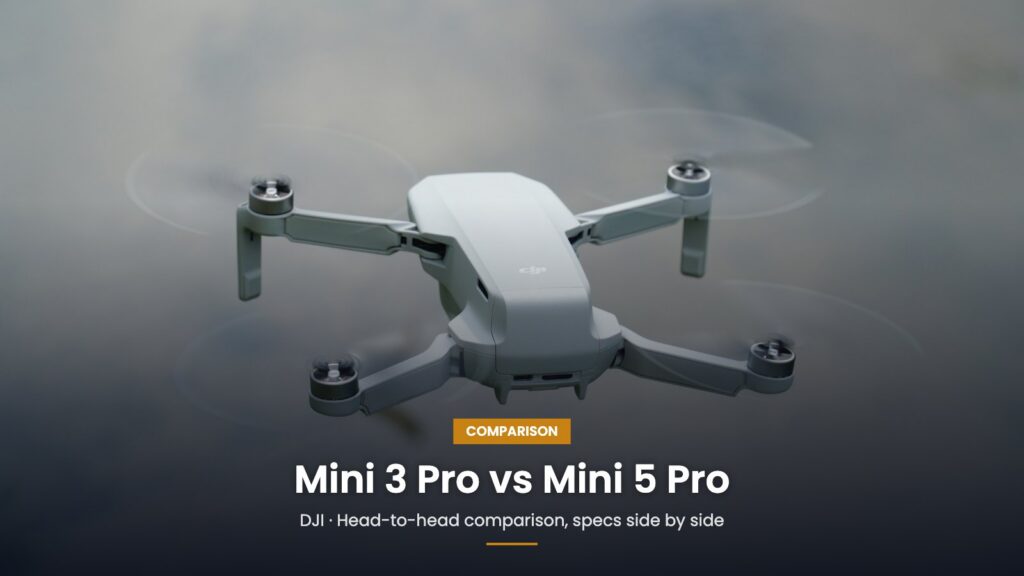
For most Mini 3 Pro owners the Mini 5 Pro is a real upgrade, not a small refresh. It moves from a 1/1.3-inch 48 MP sensor to a 1-inch 50 MP sensor, adds 10-bit D-Log M and HLG, and replaces three-direction sensing with omnidirectional vision…
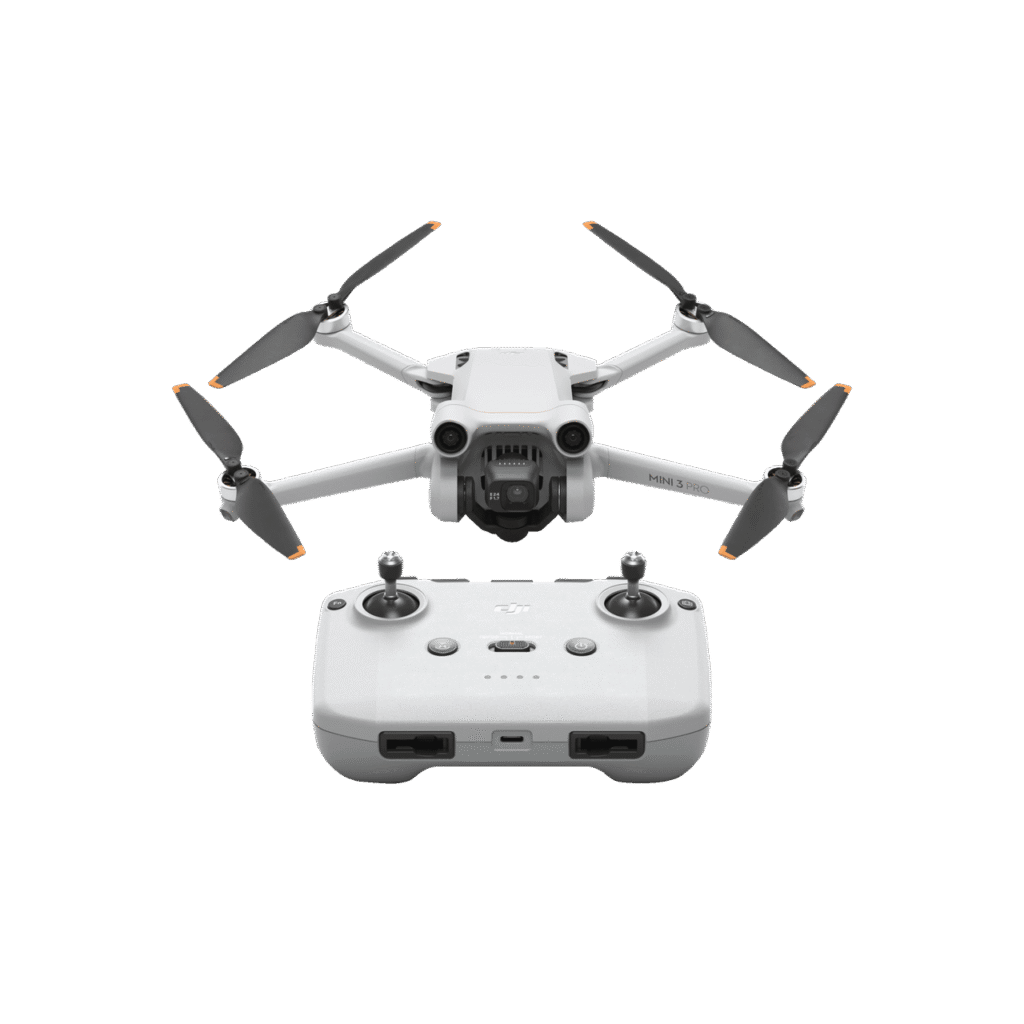
DJI Mini 3 Pro
Launched at $669 (aircraft only, 2022)
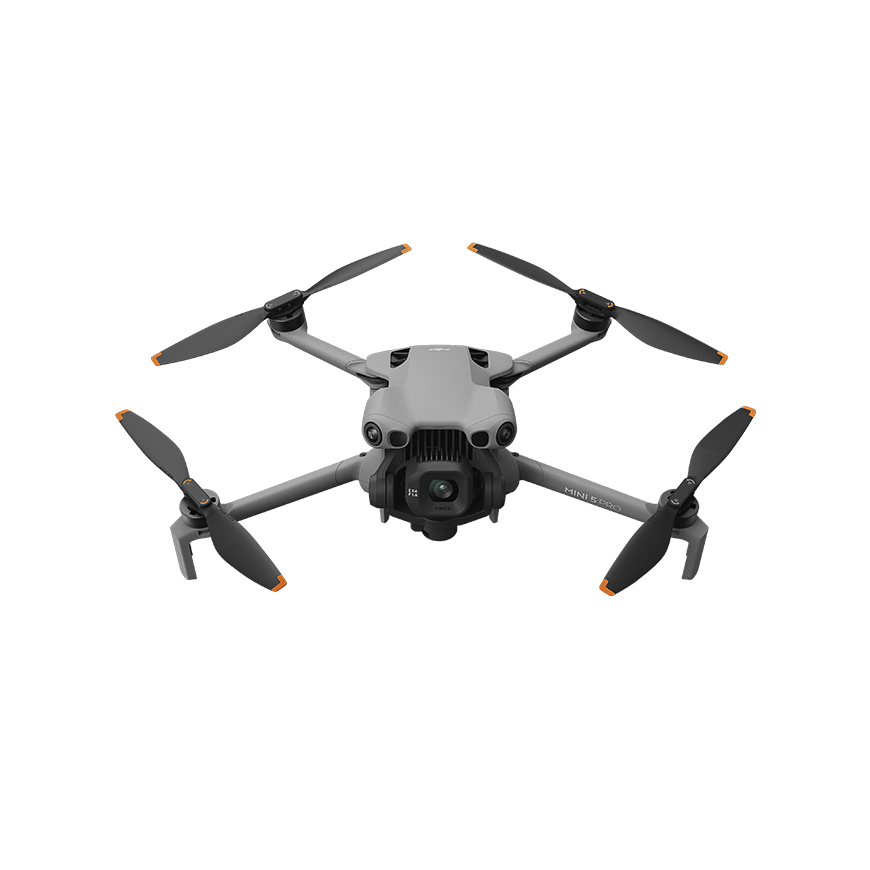
DJI Mini 5 Pro
Region-dependent; not officially sold by DJI in the US
Technical Specifications
Last updated: Oct 2026| Feature | DJI Mini 3 Pro | DJI Mini 5 Pro |
|---|---|---|
| Weight | Under 249 g with standard battery; approx. 290 g with Intelligent Flight Battery Plus | Approx. 249.9 g with standard battery (DJI notes ±4 g batch variance); heavier with Plus battery |
| Dimensions | 145×90×62 mm folded; 171×245×62 mm unfolded without propellers | 157×95×68 mm folded; 255×181×91 mm unfolded without propellers |
| Volume | Approx. 809 cm³ folded bounding-box volume | Approx. 1,014 cm³ folded bounding-box volume |
| Max Speed | 16 m/s in Sport mode (manufacturer-stated) | 18 m/s standard battery; 19 m/s Plus battery (manufacturer-stated) |
| Max Flight Distance | 18 km standard; 25 km Plus (manufacturer-stated) | 21 km standard; 32 km Plus (manufacturer-stated) |
| Sensor Size | 1/1.3-inch CMOS, dual native ISO | 1-inch CMOS |
| Megapixels | 48 MP | 50 MP |
| Max ISO | ISO 100-6,400 (video and photo) | Video: ISO 12,800 Normal; 3,200 D-Log M/HLG |
| Flight Time | 34 minutes standard; 47 minutes Plus (manufacturer-stated) | 36 minutes standard; 52 minutes Plus (manufacturer-stated) |
| Max Resolution | 4K up to 60fps; FHD/120fps slow motion; HDR video at 24/25/30fps | 4K/60fps HDR; 4K/120fps slow motion; FHD/240fps |
| Movie Bitrate | 150 Mbps (H.264/H.265) | 130 Mbps (H.264/H.265) |
| Field of View | 82.1° | 84° |
| Transmission Range | DJI O3: 12 km FCC; 8 km CE/SRRC/MIC | DJI O4+: 20 km FCC; 10 km CE/SRRC/MIC |
| Wind Resistance | 10.7 m/s (Level 5) | 12 m/s |
| Obstacle Avoidance | Tri-directional vision sensing: forward, backward and downward; no lateral or upward sensing | Omnidirectional vision with forward-facing LiDAR and downward infrared (Nightscape sensing) |
| Battery Power | 2453 mAh, 18.1 Wh standard; 3850 mAh, 28.4 Wh Plus | 2788 mAh, 19.52 Wh standard; 4680 mAh, 33.51 Wh Plus (not available in the EU) |
| Charge Time | Standard: approx. 64 min in aircraft or 56 min in charging hub; Plus: approx. 101 min or 78 min (30W charger) | Standard: approx. 69 min in aircraft or 46 min in charging hub; Plus: approx. 94 min or 56 min |
| Internal Storage | None; microSD card required | 42 GB plus microSD |
| GPS | Yes, GPS + Galileo + BeiDou | Yes, GPS + Galileo + BeiDou |
| Obstacle Detection | Yes, forward, backward and downward | Yes, omnidirectional vision plus forward LiDAR |
| Return to Home | Yes | Yes, Smart RTH with route-memory support |
| Removable Battery | Yes | Yes |
| Shoots RAW | Yes, JPEG and DNG RAW | Yes, JPEG and DNG RAW |
| HDR Mode | Yes, HDR video at 24/25/30fps and HDR photos | Yes, 4K/60fps HDR video |
| Weather Sealed | No official IP rating | No; DJI states it is not waterproof |
| Best For | Owners and used buyers who want tracking and 4K/60fps without paying for a flagship | Creators who want better low-light images, 10-bit color and sensing that works at night |
| Color Profiles | Normal and D-Cinelike, 8-bit | Normal, HLG and D-Log M, 10-bit |
| Maximum HDR Video | HDR at 24/25/30fps | 4K/60fps HDR |
| Slow Motion | FHD/120fps | 4K/120fps and FHD/240fps |
| Gimbal Roll | True Vertical (90° rotation) | 225° rotation, controllable -180° to 45° |
| Max Takeoff Altitude | 4,000 m standard; 3,000 m Plus | 6,000 m standard; 4,500 m Plus |
| Aperture | f/1.7 | f/1.8 |
Two generations in one upgrade
The Mini 3 Pro launched in May 2022 and brought obstacle sensing and True Vertical Shooting to the Mini line. The Mini 4 Pro added omnidirectional sensing and O4 in 2023, and the Mini 5 Pro arrived in September 2025 as the first Mini with a 1-inch sensor. A Mini 3 Pro owner gets both steps at once.
What changes
- Sensor: 1/1.3-inch 48 MP to 1-inch 50 MP
- Color: 8-bit D-Cinelike to 10-bit D-Log M and HLG
- Video: 4K/60fps to 4K/60fps HDR and 4K/120fps
- Sensing: three directions to omnidirectional plus forward LiDAR
- Transmission: O3 at 12 km FCC to O4+ at 20 km FCC (8 km to 10 km CE)
- Storage: none to 42 GB internal
The 1-inch sensor and 10-bit color are the real reasons
The Mini 3 Pro still produces clean daylight footage, and its f/1.7 lens is slightly brighter than the Mini 5 Pro's f/1.8. The difference is sensor area: the 1-inch sensor gathers much more light, which shows at sunrise, sunset, under city lights and in high-contrast scenes.
The video pipeline changed even more. The Mini 3 Pro records 8-bit with an optional D-Cinelike profile, and its HDR video stops at 30fps. The Mini 5 Pro records 10-bit D-Log M and HLG, offers 4K/60fps HDR and adds 4K/120fps. If you color grade, 10-bit files hold up much better when you push exposure. Don't read much into bitrate: the Mini 3 Pro lists 150 Mbps and the Mini 5 Pro 130 Mbps, but the newer drone records more efficient 10-bit H.265.
Both shoot vertically. The Mini 3 Pro rotates its gimbal 90 degrees; the Mini 5 Pro goes to 225 degrees for rolling and angled shots.
Sensing: three directions against all of them
The Mini 3 Pro watches forward, backward and downward, so the sides and top are blind spots during orbits and tracking shots. The Mini 5 Pro senses in all directions and adds a forward LiDAR sensor that DJI markets as Nightscape sensing for low light. No system catches every thin branch or wire, but the coverage gap is large.
Batteries don't carry over
Rated endurance improves only a little: 36 versus 34 minutes on standard batteries, and 52 versus 47 minutes with Plus batteries. The Mini 5 Pro's packs are larger (2788 mAh versus 2453 mAh) and the two models do not share batteries, so upgrading means buying a new set. The built-in 42 GB also means a forgotten microSD card no longer ends a shoot.
On weight, DJI lists the Mini 5 Pro at about 249.9 g with the standard battery and notes a batch variance of about 4 g; the Plus battery makes it heavier. Check your local registration rules, or use the registration-by-weight guide.
Availability in the US
DJI did not announce official US sales of the Mini 5 Pro. The Mini 3 Pro was authorized and sold in the US before the December 2025 FCC Covered List update, so it is easier to find there, mostly used. US buyers looking at a Mini 5 Pro should confirm warranty and support through an authorized channel first. The US drone ban checker covers the status of each model.
Who should upgrade
Upgrade if you
- Shoot at golden hour, blue hour or night
- Color grade and want 10-bit D-Log M
- Need slow motion at 4K
- Fly near trees or structures
- Want built-in storage as a backup
Keep the Mini 3 Pro if you shoot daylight travel clips, post to social media without grading and your batteries are healthy. For everyone else, the Mini 5 Pro is the better long-term drone. For the in-between model, see Mini 5 Pro vs Mini 4 Pro.
DJI Mini 3 Pro
Strengths
- 1/1.3-inch 48 MP sensor with an f/1.7 lens
- FocusTrack with ActiveTrack 4.0 for solo filming
- True Vertical Shooting with a rotating gimbal
- Launched at $669, well below current flagship Minis
- Batteries and accessories are easy to find
Drawbacks
- Obstacle sensing covers only forward, backward and downward
- 8-bit color; no D-Log M or HLG
- O3 range tops out at 12 km FCC
- No internal storage
- 34-minute standard flight time
DJI Mini 5 Pro
Strengths
- 1-inch 50 MP sensor
- 10-bit D-Log M and HLG plus 4K/60fps HDR
- 4K/120fps slow motion
- Omnidirectional sensing with forward LiDAR
- O4+ transmission up to 20 km FCC
- 42 GB internal storage and 225° gimbal rotation
Drawbacks
- Not officially sold by DJI in the US
- About 249.9 g with the standard battery leaves little margin
- Larger folded size than the Mini 3 Pro
- Plus battery is not available in the EU
- 10-bit and 4K/120fps files are larger
Upgrade if you shoot at dusk, grade footage or fly near obstacles
For most Mini 3 Pro owners the Mini 5 Pro is a real upgrade, not a small refresh. It moves from a 1/1.3-inch 48 MP sensor to a 1-inch 50 MP sensor, adds 10-bit D-Log M and HLG, and replaces three-direction sensing with omnidirectional vision plus forward LiDAR.
Two generations separate these drones. Transmission goes from O3 (12 km FCC) to O4+ (20 km FCC), the Mini 5 Pro adds 42 GB of internal storage, and its gimbal rotates 225 degrees.
If your Mini 3 Pro works and you shoot mostly in daylight, keep it. It still has ActiveTrack 4.0, True Vertical Shooting and 4K/60fps, and it is a sensible lower-cost used buy. US buyers should also note that DJI does not officially sell the Mini 5 Pro there.
Check DJI Mini 5 Pro price on Amazon →Affiliate link. We may earn a commission at no extra cost to you.
Context and limitations
Mini 5 Pro is a multi-generation upgrade over the Mini 3 Pro: 1-inch sensor, 10-bit color, LiDAR-assisted omnidirectional sensing and O4+. The Mini 3 Pro remains a capable, cheaper used option for daylight shooting.
Limitations
Specification-based comparison; no hands-on test. Mini 5 Pro is not officially sold by DJI in the US. Mini 3 Pro data comes from DJI support pages because the original spec page now redirects. Plus batteries change aircraft weight and can change registration requirements.
The Friday Brief
One email a week on what changed in drones
FCC and FAA rule changes, DJI leaks checked against filings, and the week’s new comparisons. Every Friday, nothing else.
Free. Unsubscribe in one click. Sent with Kit; see our privacy policy.
Follow us on Google too: add Drone Ranker as a preferred source →

Alihan Demirdaş is the founder and editor of Drone Ranker. A software developer by profession, he researches drones the way he reads code: from the primary documents. Every review, comparison and news story on the site is written by him from manufacturer specification sheets, FCC and EU certification filings, aviation-authority rules and dated press releases, with the source linked. Unless a page is labelled hands-on, the analysis is documentary; when an aircraft is in his hands, the page says so and carries his own photographs and flight notes. He covers consumer, professional and agricultural drones and is based in Türkiye.