U.S. Air Force Wants DJI Drones for Nuclear Missile Base Training

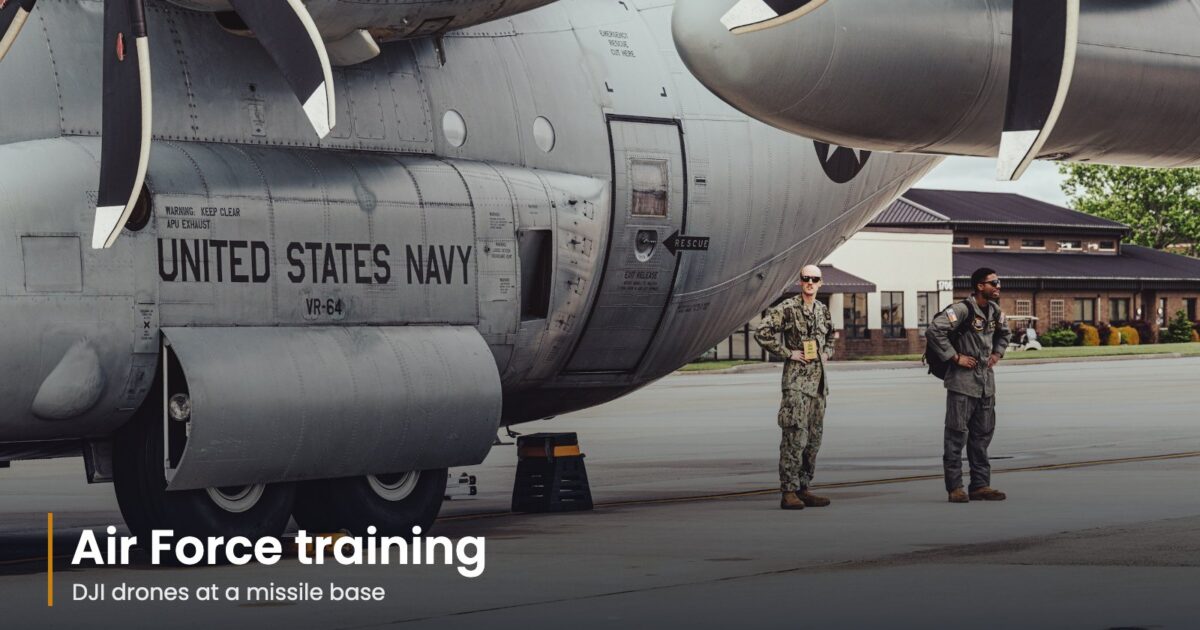
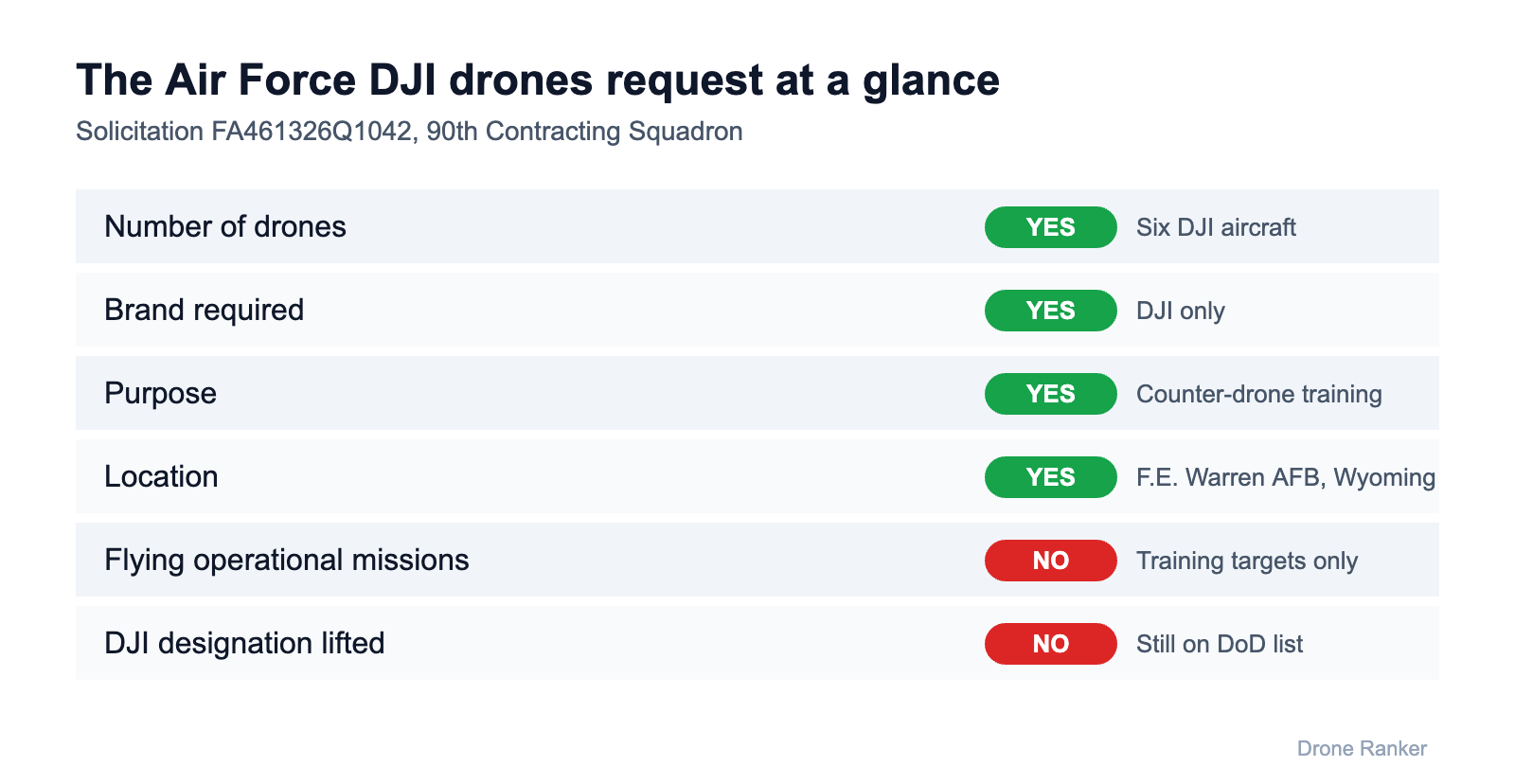
Air Force DJI drones sound like a contradiction, given the Pentagon’s own designation of DJI. The U.S. Air Force is asking for quotes on six DJI drones to train counter-drone teams at F.E. Warren Air Force Base in Wyoming, one of the country’s nuclear missile bases. The aircraft would play the enemy.
The notice, from the 90th Contracting Squadron, calls for brand-name DJI aircraft to support the 90th Missile Security Operations Squadron’s counter-small UAS training. The idea is to let personnel and counter-UAS equipment train against real DJI aircraft, with the radio signatures and flight behavior they could meet in the real world, rather than against simulated substitutes.
The timing is awkward for Washington. DJI is fighting its designation on a Pentagon list of Chinese military companies, while another part of the defense establishment wants its hardware because it is hard to imitate.
Table of Contents
What the Air Force is asking for
The solicitation, FA461326Q1042, is a small-business set-aside. Questions were due August 19 and quotes are due August 24, 2026. It lists:
- 2 refurbished DJI Mavic 2 Pro bundles
- 2 DJI Mini 3 Pro aircraft
- 2 DJI Avata 2 Fly More Combos
- 6 payload-release systems
Every drone must be DJI. That is not because the Air Force sees them as the best choice for normal military flying. The training unit wants realistic “Red Fleet” targets; in military training, red forces stand in for the adversary.
Why the Air Force DJI drones have to be real DJI hardware
According to reporting based on the Air Force’s justification documents, the service believes DJI’s proprietary radio protocols, electronic signatures and flight behavior cannot be adequately reproduced with U.S.- or allied-made substitutes. If security personnel are expected to face DJI drones as threats, something that only looks like one is not good enough. Detection systems, RF sensors, jammers, electronic-warfare and tracking equipment, and the people running them, all need to deal with the real signals.
So the point is not learning to fly DJI drones. It is learning to detect and defeat them in force-on-force exercises.
Why the Air Force wants DJI drones at this base
F.E. Warren is home to the 90th Missile Wing, one of the units responsible for the Minuteman III intercontinental ballistic missile force. The wing operates and supports 150 Minuteman III ICBMs and their launch facilities, and the Air Force describes the base as a key part of America’s land-based nuclear deterrent.
Small commercial quadcopters are cheap, easy to get and hard to tell apart from harmless aircraft at a distance. For security forces guarding strategic sites, realistic counter-drone training has obvious value.
Handling the security risk
Reporting on the procurement says the aircraft are expected to receive RIZER software modifications designed to isolate them from external networks. The setup would limit cloud connectivity and outside data transmission, leaving the drones air-gapped before they are used in training. The Air Force wants the authentic RF and flight characteristics while trying to reduce the cybersecurity concerns of flying foreign-made aircraft around a sensitive facility.
DJI is still blacklisted
DJI is challenging the Department of Defense’s designation of it as a Chinese military company. A federal appeals court recently gave DJI a partial win, sending part of the Pentagon’s justification back to a lower court, but DJI has not been removed from the Pentagon blacklist. That case is separate from this procurement.
Headlines along the lines of “Air Force buys Chinese drones for nuclear bases” give the wrong impression. Nothing in the notice suggests the Mavic 2 Pro, Mini 3 Pro or Avata 2 would carry out any part of the nuclear mission or be used as combat aircraft. They are training targets.
What happens next
This is a request for quotes, not a completed purchase. After August 24 a contract could go to a qualifying supplier that meets the technical requirements.
This is not a softening of the U.S. position on DJI. Washington is still tightening restrictions on foreign drone technology and defending DJI’s place on security lists. But it is a candid admission that DJI’s footprint is big enough that the people defending against drones need the real thing to practice on, and I expect more counter-UAS units to make the same argument.
DJI drones still sold in the US
DJI Mini 4 Pro (RC-N2)
Under 249 g, omnidirectional sensing without LiDAR, still in DJI’s US line-up.
151 g, 4K/60 and omnidirectional sensing. The current Neo you can buy in the US.
DJI Air 3S (RC-N3)
1-inch main camera plus a 70 mm tele, up to 45 min. One of the models the FCC LiDAR proposal could reach.
As an Amazon Associate, Drone Ranker earns from qualifying purchases. We do not quote prices because Amazon’s change by the hour.
Last updated: August 18, 2026.
The Friday Brief
One email a week on what changed in drones
FCC and FAA rule changes, DJI leaks checked against filings, and the week’s new comparisons. Every Friday, nothing else.
Free. Unsubscribe in one click. Sent with Kit; see our privacy policy.
Follow us on Google too: add Drone Ranker as a preferred source →
Continue Reading
All News