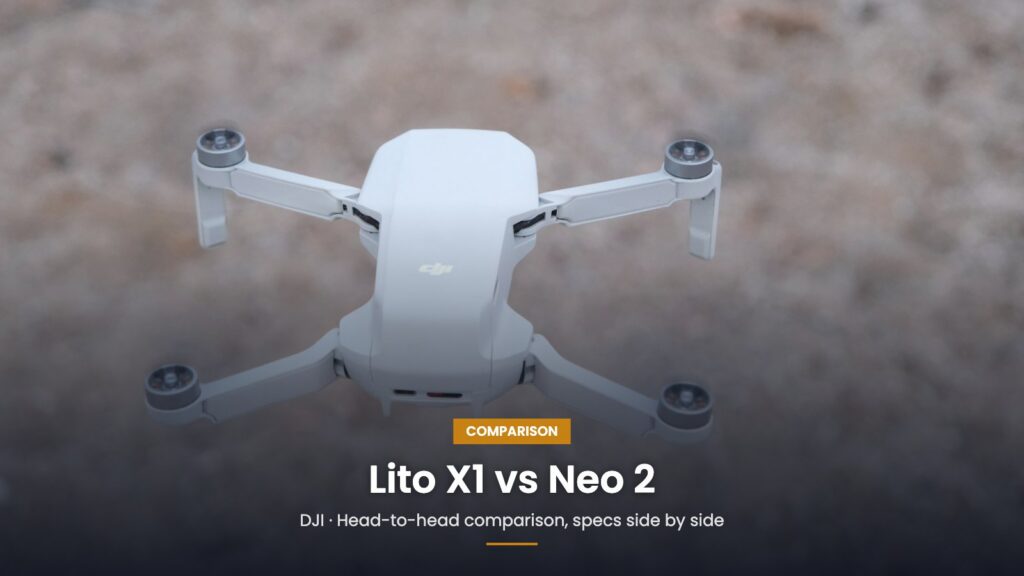
DJI Lito X1 vs DJI Neo 2
For most buyers the DJI Lito X1 is the better drone: a 1/1.3-inch 48 MP camera on a 3-axis gimbal, 36 minutes of rated flight and DJI O4 with up to 15 km of range. Pick the DJI Neo 2 only if what you want…
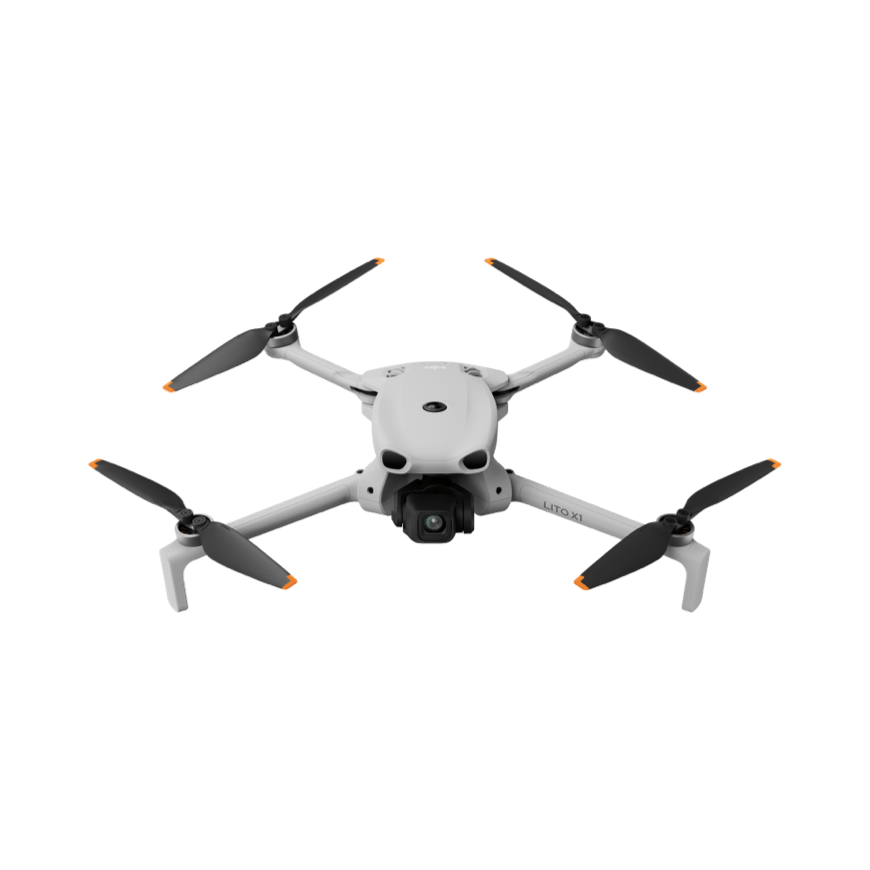
DJI Lito X1
Launched at €419 aircraft only (EU, April 2026); no official US price
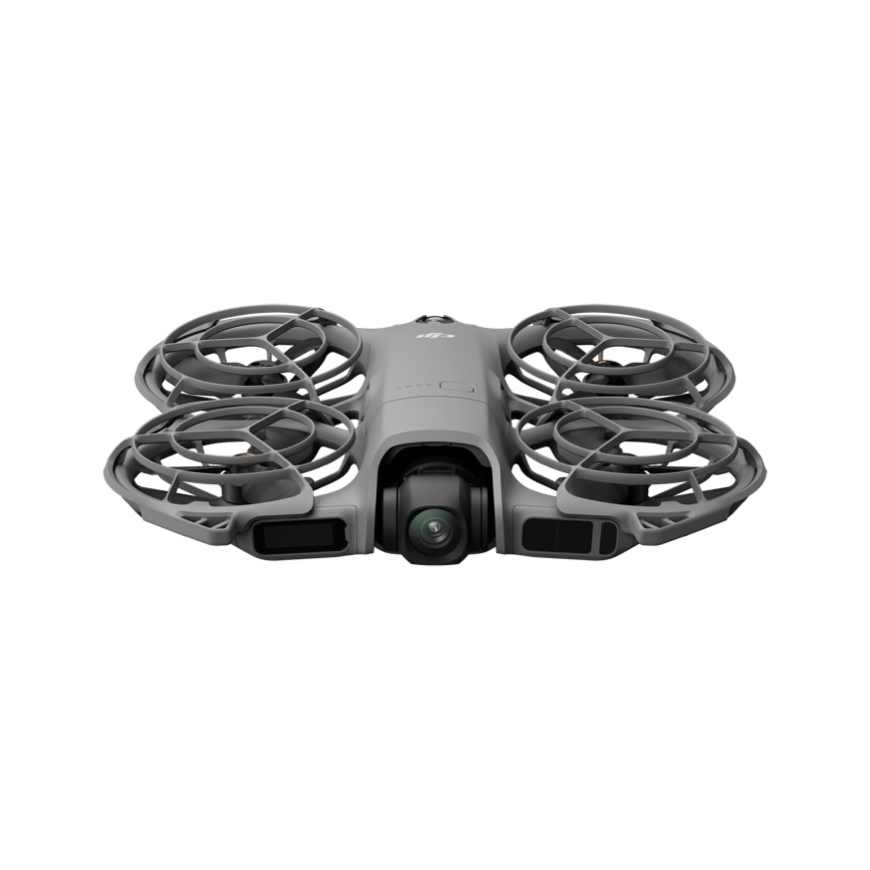
DJI Neo 2
Launched at €239 aircraft only (EU, Nov 2025); no official US price
Technical Specifications
Last updated: Oct 2026| Feature | DJI Lito X1 | DJI Neo 2 |
|---|---|---|
| Weight | Approx. 249 g with standard battery; up to approx. 340 g takeoff weight with Plus battery | 151 g; 160 g with optional Digital Transceiver |
| Dimensions | 144×94×62 mm folded; 183×251×79 mm unfolded without propellers | 147×171×41 mm (non-folding, integrated guards); 167×171×54 mm with transceiver |
| Volume | Approx. 839 cm³ folded bounding-box volume | Approx. 1,031 cm³ bounding-box volume |
| Max Speed | 18 m/s Sport; 12 m/s Normal and tracking (manufacturer-stated) | 12 m/s Sport and tracking; 8 m/s Normal (manufacturer-stated) |
| Max Flight Distance | 21 km standard; 32 km Plus (manufacturer-stated) | 7 km (manufacturer-stated) |
| Sensor Size | 1/1.3-inch CMOS | 1/2-inch CMOS |
| Megapixels | 48 MP | 12 MP |
| Max ISO | Video: ISO 12,800 Normal; 3,200 D-Log M | Video: ISO 100-12,800 |
| Flight Time | 36 minutes standard; 52 minutes Plus (manufacturer-stated) | Approx. 19 minutes (approx. 17 minutes with guards); single battery type |
| Max Resolution | 4K/60fps HDR; 4K/100fps slow motion; FHD/200fps; 2.7K vertical crop up to 60fps | 4K/60fps; 4K/100fps slow motion; 2.7K vertical up to 60fps |
| Movie Bitrate | 130 Mbps | 80 Mbps |
| Field of View | 82.1° | 119.8° |
| Transmission Range | DJI O4: 15 km (IC); 8 km CE/SRRC/MIC | Wi-Fi up to 500 m; with optional O4 Digital Transceiver: 10 km FCC, 6 km CE/SRRC/MIC |
| Wind Resistance | 10.7 m/s (Level 5) | 10.7 m/s (Level 5) |
| Obstacle Avoidance | Omnidirectional monocular vision with forward-facing LiDAR and downward infrared | Omnidirectional monocular vision with forward LiDAR (0.3-8 m) and downward infrared |
| Battery Power | 2788 mAh, 19.52 Wh standard; 4680 mAh, 33.51 Wh Plus | 1606 mAh, 11.5 Wh (no Plus battery) |
| Charge Time | Approx. 45 min standard or 56 min Plus in charging hub with DJI 65W charger | Approx. 70 min in aircraft (15W); approx. 68 min for three batteries in 65W hub |
| Internal Storage | 42 GB plus microSD | 49 GB; no microSD slot |
| GPS | Yes, GPS + Galileo + BeiDou | Yes, GPS + Galileo + BeiDou |
| Obstacle Detection | Yes, omnidirectional vision plus forward LiDAR | Yes, omnidirectional vision plus forward LiDAR |
| Return to Home | Yes, with route-memory assistance under supported conditions | Yes, including Return-to-Palm |
| Removable Battery | Yes | Yes |
| Shoots RAW | Yes, JPEG and DNG RAW | No, JPEG only |
| HDR Mode | Yes, 4K/60fps HDR video | No HDR mode listed |
| Weather Sealed | No official IP rating | No official IP rating |
| Best For | Travel and scenery shooters who want RAW, D-Log M and long flights | Hikers, cyclists and vloggers who want selfie clips without a controller |
| Controller-Free Flight | No; flown with DJI RC 2 or RC-N3 | Yes; palm, gesture, voice and phone control |
| Gimbal | 3-axis mechanical | 2-axis mechanical plus EIS |
| Color Profiles | Normal and 10-bit D-Log M | Normal only |
| Propeller Guards | Not integrated | Integrated full guards |
| Plus Battery Option | Yes, 52 minutes rated | No; single battery type |
| Max Takeoff Altitude | 4,500 m standard; 3,500 m Plus | 2,000 m |
A camera drone and a selfie drone
People cross-shop these two because both are small, both are recent and both use forward LiDAR with omnidirectional vision sensing. They solve different problems. The Lito X1 is a folding drone you fly with a DJI RC 2 or RC-N3 controller to capture scenery. The Neo 2 is a guarded drone you launch from your hand to film yourself. Neither was officially sold in the US at launch: DJI gave the Lito X1 no US price, and press coverage reports it is not sold there.
The Lito X1 has the far better camera
The Lito X1 pairs its 1/1.3-inch 48 MP sensor with an f/1.7 lens and a 3-axis gimbal. It records 4K/60fps HDR, offers 10-bit D-Log M for grading and saves DNG RAW stills, which is a complete toolkit for scenic and travel work.
The Neo 2 uses a 1/2-inch 12 MP sensor with a 119.8-degree field of view on a 2-axis gimbal plus electronic stabilization. It records 4K/60fps and 4K/100fps slow motion, which is impressive for its size, but it saves JPEG only and has no log profile. The wide lens suits selfies and group shots more than distant scenery.
Flight time, range and wind
DJI rates the Lito X1 at 36 minutes with the standard battery and 52 with the Plus pack. The Neo 2 gets about 19 minutes, or about 17 with its guards, and has no larger battery. Both list Level 5 wind resistance (10.7 m/s), but the much lighter Neo 2 tops out at 12 m/s, so it has less margin in gusts.
The Lito X1's O4 link reaches up to 15 km. The Neo 2 talks to a phone over Wi-Fi to about 500 m; with the optional Digital Transceiver and an O4 controller or goggles, DJI lists 10 km (FCC) and 6 km (CE). On sensing, the Lito X1's LiDAR is specified to 36 m, the Neo 2's to about 0.3 to 8 m.
Where the Neo 2 wins: self-filming
The Neo 2 launches from your palm, returns to it, responds to gestures and voice, and records to 49 GB of internal storage. You can pull it out, grab a tracking clip on a hike and pack it away in about a minute. Its full propeller guards and 151 g weight also make close-range flying around people less risky. The Lito X1 has ActiveTrack and QuickShots too, but it needs the controller, a proper takeoff spot and exposed propellers kept at a distance.
Weight: the Lito X1 is about 249 g with the standard battery and heavier with the Plus battery; the Neo 2 is 151 g. Registration and Remote ID rules depend on your country, so check them with the registration-by-weight guide.
Plenty of creators end up with both: a Neo 2 in a jacket pocket and a Lito X1 for planned shots. If you can buy only one and want a drone you won't outgrow, I'd get the Lito X1. The Lito X1 specs analysis and Neo 2 specs analysis go into more detail.
DJI Lito X1
Strengths
- 1/1.3-inch 48 MP sensor on a 3-axis gimbal
- 4K/60fps HDR, 10-bit D-Log M and DNG RAW
- 36-minute flight time, 52 minutes with the Plus battery
- O4 transmission up to 15 km with 1080p/60fps live view
- 42 GB internal storage plus microSD
Drawbacks
- Needs a controller; no palm launch or gesture control
- Vertical video is a 2.7K crop
- Bigger, heavier and pricier than the Neo 2
- Not officially sold in the US
DJI Neo 2
Strengths
- Palm takeoff, Return-to-Palm, gesture and voice control
- 151 g with built-in propeller guards
- ActiveTrack in 8 directions up to 12 m/s
- 4K/100fps slow motion and 49 GB internal storage
Drawbacks
- About 19 minutes per battery
- 1/2-inch 12 MP sensor, JPEG only
- About 500 m Wi-Fi range without the optional transceiver
- 2-axis gimbal and no microSD slot
Get the Lito X1 for scenery, the Neo 2 for filming yourself
For most buyers the DJI Lito X1 is the better drone: a 1/1.3-inch 48 MP camera on a 3-axis gimbal, 36 minutes of rated flight and DJI O4 with up to 15 km of range. Pick the DJI Neo 2 only if what you want is quick, hands-free clips of yourself.
The Lito X1 shoots 4K/60fps HDR, 10-bit D-Log M and DNG RAW, flies nearly twice as long and copes better with wind and distance. It is the one for scenery, travel and planned cinematic shots.
The Neo 2 is a self-filming tool. At 151 g with built-in guards it launches from your palm, follows you with ActiveTrack and takes gestures, voice or a phone instead of a controller. Its 1/2-inch 12 MP sensor, JPEG-only stills and roughly 19-minute battery hold it back as a general camera drone.
Check DJI Lito X1 price on Amazon →Affiliate link. We may earn a commission at no extra cost to you.
Context and limitations
Lito X1 is the stronger camera drone (sensor, D-Log M, RAW, flight time, O4 range); Neo 2 is a controller-free palm-launch selfie drone. Choose by use case, not by headline score.
Limitations
Specification-based comparison; no hands-on test. Lito X1 figures come from DJI launch material and retailer copies of the DJI spec sheet; retailers label the 15 km range as IC or FCC inconsistently. Neither model was officially sold in the US at launch. Neo 2 range depends on whether the optional Digital Transceiver is used.
The Friday Brief
One email a week on what changed in drones
FCC and FAA rule changes, DJI leaks checked against filings, and the week’s new comparisons. Every Friday, nothing else.
Free. Unsubscribe in one click. Sent with Kit; see our privacy policy.
Follow us on Google too: add Drone Ranker as a preferred source →

Alihan Demirdaş is the founder and editor of Drone Ranker. A software developer by profession, he researches drones the way he reads code: from the primary documents. Every review, comparison and news story on the site is written by him from manufacturer specification sheets, FCC and EU certification filings, aviation-authority rules and dated press releases, with the source linked. Unless a page is labelled hands-on, the analysis is documentary; when an aircraft is in his hands, the page says so and carries his own photographs and flight notes. He covers consumer, professional and agricultural drones and is based in Türkiye.