DJI Lito X1 vs DJI Mini 3 Pro
Most new buyers should pick the Lito X1. It has the same 1/1.3-inch 48 MP sensor and f/1.7 lens as the Mini 3 Pro, but better everything around the camera: omnidirectional sensing with forward LiDAR, 4K/100fps, 10-bit D-Log M, longer battery life, O4 and 42…
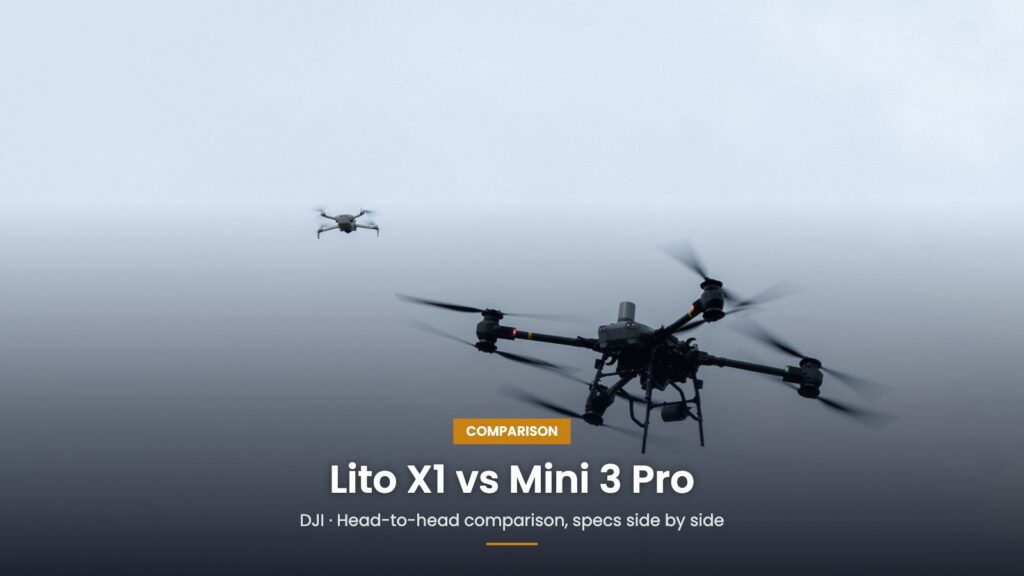
DJI Lito X1
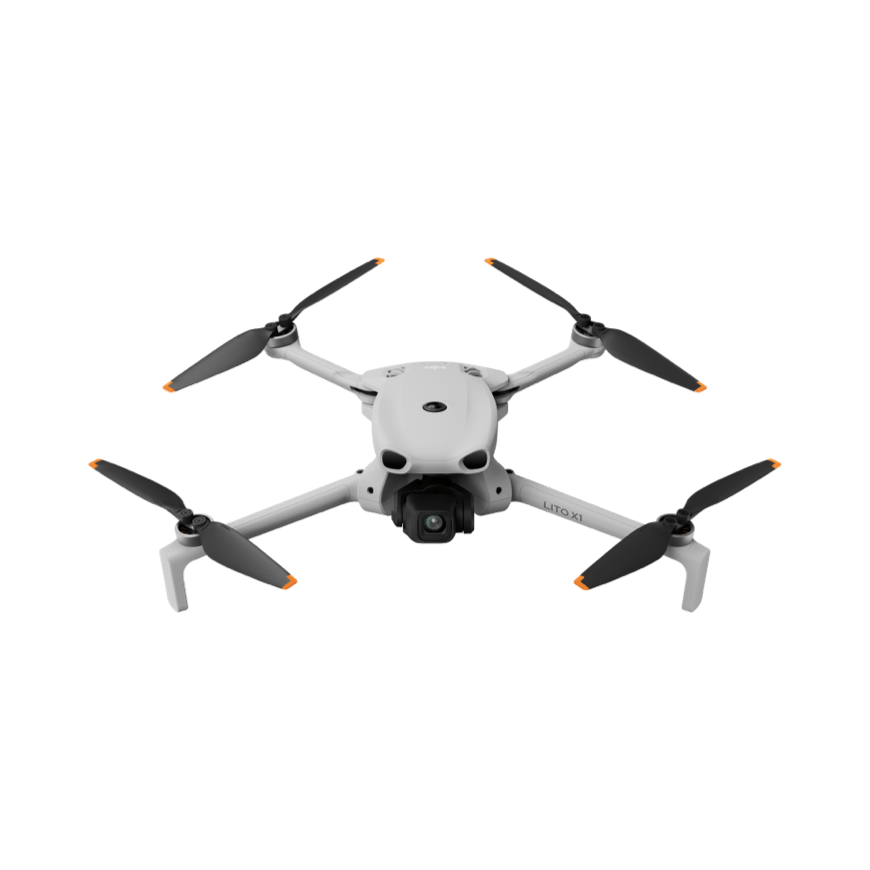
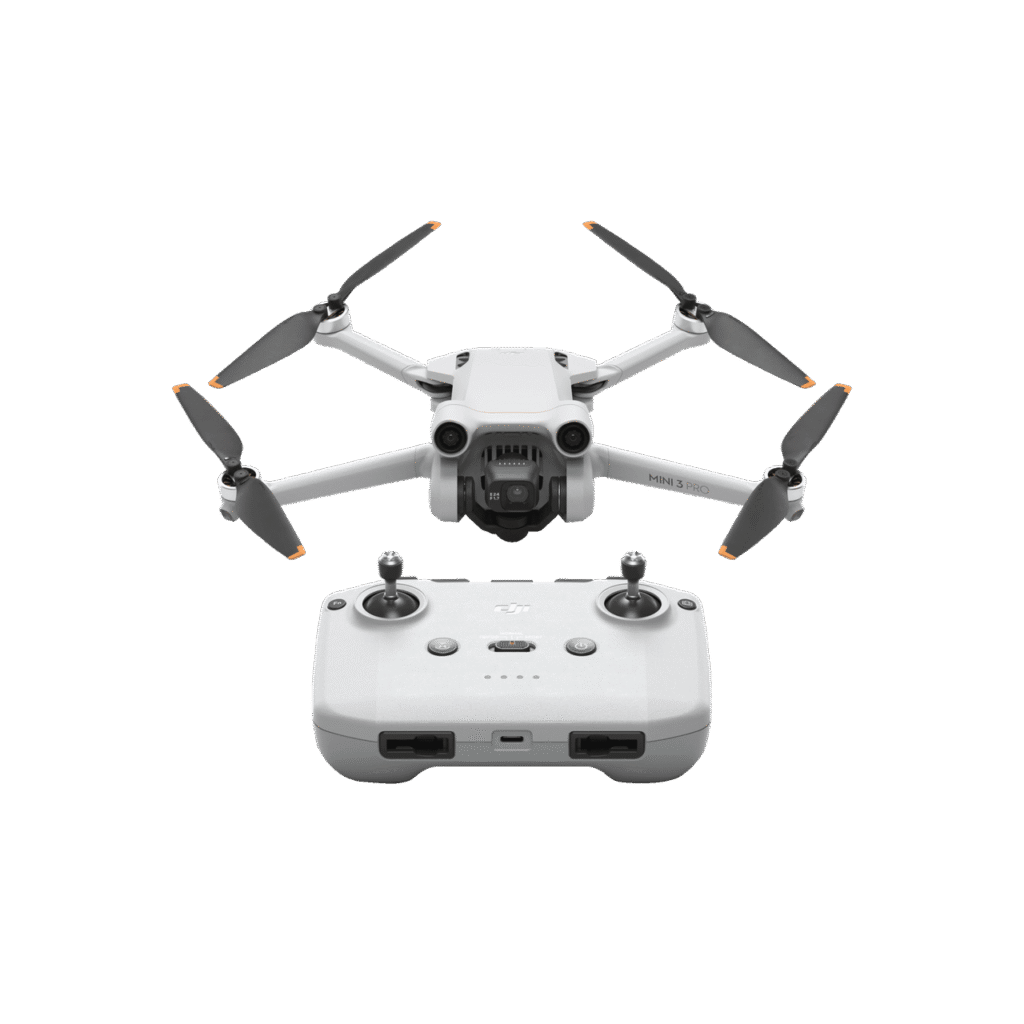
DJI Mini 3 Pro
Technical Specifications
Last updated: Oct 2026| Feature | DJI Lito X1 | DJI Mini 3 Pro |
|---|---|---|
| Weight | Approx. 249 g with standard battery; over 249 g with Intelligent Flight Battery Plus | <249 g with standard battery; approximately 290 g with Intelligent Flight Battery Plus |
| Dimensions | 144×94×62 mm folded; 183×251×79 mm unfolded without propellers | 145×90×62 mm folded; 171×245×62 mm unfolded without propellers |
| Volume | Approx. 839 cm³ folded bounding-box volume | Approx. 809 cm³ folded bounding-box volume |
| Max Speed | 18 m/s in Sport mode | 16 m/s in Sport mode |
| Max Flight Distance | 21 km standard; 32 km Plus (manufacturer-stated) | 18 km standard; 25 km Plus (manufacturer-stated) |
| Sensor Size | 1/1.3-inch CMOS | 1/1.3-inch CMOS |
| Megapixels | 48 MP | 48 MP |
| Max ISO | Video Normal up to ISO 12,800; D-Log M up to ISO 3,200 | ISO 100-6,400 for video and photos |
| Flight Time | 36 minutes standard; 52 minutes Plus (manufacturer-stated) | 34 minutes standard; 47 minutes Plus (manufacturer-stated) |
| Max Resolution | 4K up to 60fps; 4K/100fps slow motion; 2.7K vertical up to 60fps | 4K up to 60fps; FHD/120fps slow motion; True Vertical Shooting |
| Movie Bitrate | 130 Mbps | 150 Mbps |
| Field of View | 82.1° | 82.1° |
| Transmission Range | DJI O4: 15 km IC; 8 km CE/SRRC/MIC | DJI O3: 12 km FCC; 8 km CE/SRRC/MIC |
| Wind Resistance | 10.7 m/s | 10.7 m/s |
| Obstacle Avoidance | Omnidirectional monocular vision with forward-facing LiDAR and downward infrared sensing | Forward, backward and downward vision sensing |
| Battery Power | 2788 mAh standard; 4680 mAh Plus | 2453 mAh standard; 3850 mAh Plus |
| Charge Time | Approx. 45 minutes standard or 56 minutes Plus in charging hub with DJI 65W Portable Charger | Approx. 64 minutes standard battery in aircraft or 56 minutes in charging hub |
| Internal Storage | 42 GB plus microSD expansion | 1.2 GB plus microSD expansion |
| GPS | Yes, GPS + Galileo + BeiDou | Yes, GPS + Galileo + BeiDou |
| Obstacle Detection | Yes, omnidirectional vision with forward-facing LiDAR | Yes, forward, backward and downward |
| Return to Home | Yes, including route-memory assistance under supported conditions | Yes |
| Removable Battery | Yes | Yes |
| Shoots RAW | Yes, JPEG and DNG RAW | Yes, JPEG and DNG RAW |
| HDR Mode | Yes, 4K/60fps HDR | Yes, HDR video at 24/25/30fps and HDR single-shot photos |
| Weather Sealed | No official IP rating | No official IP rating |
| Best For | New buyers who want better sensing, longer flights, D-Log M and built-in storage | Vertical-video creators who find one at a good discount |
| Camera Sensor | 1/1.3-inch CMOS | 1/1.3-inch CMOS |
| Maximum Photo Resolution | 48 MP | 48 MP |
| Lens Aperture | f/1.7 | f/1.7 |
| Maximum Standard 4K | 4K/60fps | 4K/60fps |
| Maximum Slow Motion | 4K/100fps; FHD/200fps | FHD/120fps |
| Color Workflow | 10-bit D-Log M; 10-bit H.265 Normal | 8-bit D-Cinelike |
| HDR Video | 4K/60fps HDR marketing claim | HDR at 24/25/30fps |
| True Vertical Shooting | 2.7K vertical mode up to 60fps | Yes, camera physically rotates |
| Obstacle Sensing Coverage | Forward, backward, left, right, upward and downward | Forward, backward and downward |
| Forward LiDAR | Yes, 0.5-36 m measurement range under stated conditions | No |
| Standard Flight Time | 36 minutes | 34 minutes |
| Plus Flight Time | 52 minutes | 47 minutes |
| Standard Battery Capacity | 2788 mAh | 2453 mAh |
| Plus Battery Capacity | 4680 mAh | 3850 mAh |
| Standard Flight Distance | 21 km | 18 km |
| Plus Flight Distance | 32 km | 25 km |
| Maximum Sport Speed | 18 m/s | 16 m/s |
| Transmission System | DJI O4 | DJI O3 |
| Headline Transmission | 15 km IC | 12 km FCC |
| CE Transmission Range | 8 km | 8 km |
| Live View | Up to 1080p/60fps | 1080p/30fps |
| Internal Storage | 42 GB | 1.2 GB |
| QuickTransfer | Wi-Fi 6 up to 50 MB/s | Wi-Fi 5 up to 25 MB/s |
| Operating Temperature | -10°C to 40°C | -10°C to 40°C |
The same sensor, so the camera is not the deciding factor
Both drones use a 1/1.3-inch 48 MP sensor with an f/1.7 lens. The Lito X1 does not win on sensor size. Where it moves ahead is the recording pipeline: 4K/100fps slow motion and 10-bit D-Log M in H.265. The Mini 3 Pro records 4K up to 60fps and Full HD up to 120fps in 8-bit D-Cinelike, with no D-Log, though its 150 Mbps maximum bitrate beats the Lito X1's 130 Mbps.
Vertical video still favors the Mini 3 Pro
The Mini 3 Pro rotates its camera 90° for portrait shots, which is the simplest route to Reels, TikTok and Shorts. The Lito X1 records a dedicated 1512×2688 vertical format at up to 60fps. Useful, but not the same as a rotating camera.
Obstacle sensing is the biggest upgrade
The Lito X1 uses omnidirectional monocular vision plus forward LiDAR and a downward infrared sensor, covering forward, backward, sideways, up and down. DJI rates the LiDAR from 0.5 to 36 m under stated conditions. The Mini 3 Pro only senses forward, backward and downward, so sideways and upward moves are on you. Neither is collision-proof: wires, small or dark objects and difficult light can still slip past.
Battery, weight and range
DJI rates the Lito X1 at 36 minutes standard and 52 minutes with the Plus battery, against 34 and 47 for the Mini 3 Pro. Maximum flight distance is 21 and 32 km against 18 and 25 km, measured in controlled tests rather than as a usable one-way distance.
Weight is a tie. The Lito X1 is about 249 g and the Mini 3 Pro is listed below 249 g with standard batteries; both go over with Plus batteries, which can change the rules where you fly.
Be careful with the range headlines. The Lito X1's 15 km is an IC figure and the Mini 3 Pro's 12 km is FCC, so they are not directly comparable. Under CE both are rated at 8 km. The Lito X1 uses O4 with a 1080p/60fps live view, the Mini 3 Pro O3 at 1080p/30fps.
Storage and transfers
The Lito X1 has 42 GB built in and Wi-Fi 6 QuickTransfer up to 50 MB/s. The Mini 3 Pro has 1.2 GB, enough only as an emergency fallback, and Wi-Fi 5 downloads up to 25 MB/s. Both take microSD cards. For the Lito X1 against a newer Mini, see Lito X1 vs Mini 4 Pro.
DJI Lito X1
Strengths
- Omnidirectional sensing with forward LiDAR
- 4K/100fps slow motion and 10-bit D-Log M
- 36-minute standard and 52-minute Plus flight time
- 42 GB internal storage plus microSD
- O4 transmission with 1080p/60fps live view
- 18 m/s top speed and Wi-Fi 6 QuickTransfer up to 50 MB/s
Drawbacks
- No rotating camera; vertical video is a dedicated 1512×2688 format
- 130 Mbps maximum bitrate, below the Mini 3 Pro's 150 Mbps
- Plus battery takes it above 249 g
- Costs more than a discounted or used Mini 3 Pro
DJI Mini 3 Pro
Strengths
- True Vertical Shooting with a rotating camera
- Same 1/1.3-inch 48 MP sensor and f/1.7 lens
- 150 Mbps maximum bitrate
- Slightly smaller folded body
- Often much cheaper, especially used
Drawbacks
- No side or upward sensing and no LiDAR
- 34/47-minute battery ratings
- 8-bit D-Cinelike, no D-Log
- 120fps slow motion only at Full HD
- Only 1.2 GB internal storage
- Older O3 transmission
Buying new? Get the Lito X1
Most new buyers should pick the Lito X1. It has the same 1/1.3-inch 48 MP sensor and f/1.7 lens as the Mini 3 Pro, but better everything around the camera: omnidirectional sensing with forward LiDAR, 4K/100fps, 10-bit D-Log M, longer battery life, O4 and 42 GB of storage.
The Mini 3 Pro is still worth it at a big discount, especially for vertical video. Its camera physically rotates for True Vertical Shooting, and it has a higher 150 Mbps bitrate. If you already own Mini 3-series batteries and accessories, that tips it further.
Mini 3 Pro owners who are happy with True Vertical Shooting and 4K/60fps don't need to rush the upgrade.
Check DJI Lito X1 price on Amazon →Affiliate link. We may earn a commission at no extra cost to you.
Context and limitations
This comparison helps buyers choose between DJI Lito X1 and DJI Mini 3 Pro by translating the specification table into camera, flight, safety, workflow and value decisions. Recommendations are matched to user needs rather than based on a single headline number.
Limitations
The Friday Brief
One email a week on what changed in drones
FCC and FAA rule changes, DJI leaks checked against filings, and the week’s new comparisons. Every Friday, nothing else.
Free. Unsubscribe in one click. Sent with Kit; see our privacy policy.
Follow us on Google too: add Drone Ranker as a preferred source →

Alihan Demirdaş is the founder and editor of Drone Ranker. A software developer by profession, he researches drones the way he reads code: from the primary documents. Every review, comparison and news story on the site is written by him from manufacturer specification sheets, FCC and EU certification filings, aviation-authority rules and dated press releases, with the source linked. Unless a page is labelled hands-on, the analysis is documentary; when an aircraft is in his hands, the page says so and carries his own photographs and flight notes. He covers consumer, professional and agricultural drones and is based in Türkiye.