DJI AeroScope Vulnerability: Four Alarming Flaws Give Root Access, and There Is No Fix

A DJI AeroScope vulnerability disclosure published on 13 November 2026 lists four separate flaws in AeroScope Mobile, the portable version of DJI’s drone-detection system. The worst two can give an attacker on the same network root control of the device, and none of the four has a fix, because the product is no longer supported.
Each DJI AeroScope vulnerability was published as CVE-2026-128907 to CVE-2026-128910 by Switzerland’s National Cyber Security Centre (NCSC), which acted as the CVE numbering authority. They were found by Llorenç Romá Alvarez of Switzerland’s Cyber Defence Campus. You can read the official record for the most serious one on CVE.org.
In this story
What AeroScope Mobile is
AeroScope is DJI’s own system for spotting DJI drones in the air. It listens for the identification signals DJI aircraft broadcast and shows their position, and often the pilot’s position, to whoever runs it. Airports, prisons, police and event security teams have used it. AeroScope Mobile (model TP703) is the portable, case-sized version.
The affected units run AeroScope Mobile firmware 03.00.00.26 with communications board firmware 02.00.07.12 through 02.00.08.40. The CVE records are tagged “unsupported when assigned”, meaning DJI no longer supports the product.
Each DJI AeroScope vulnerability, from worst to least severe
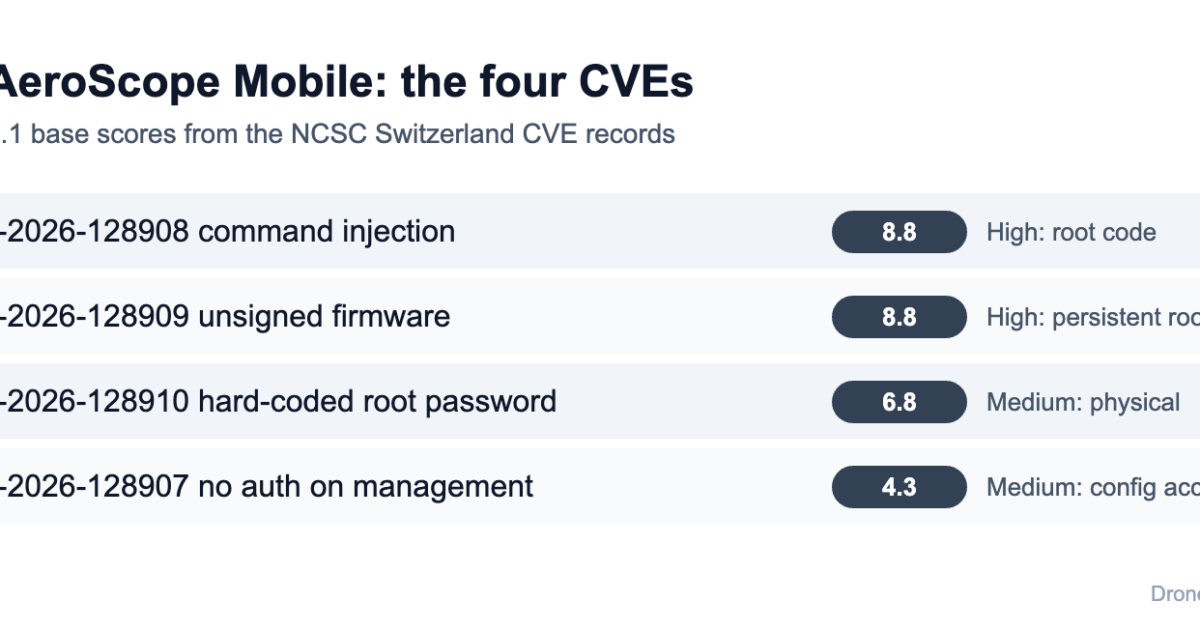
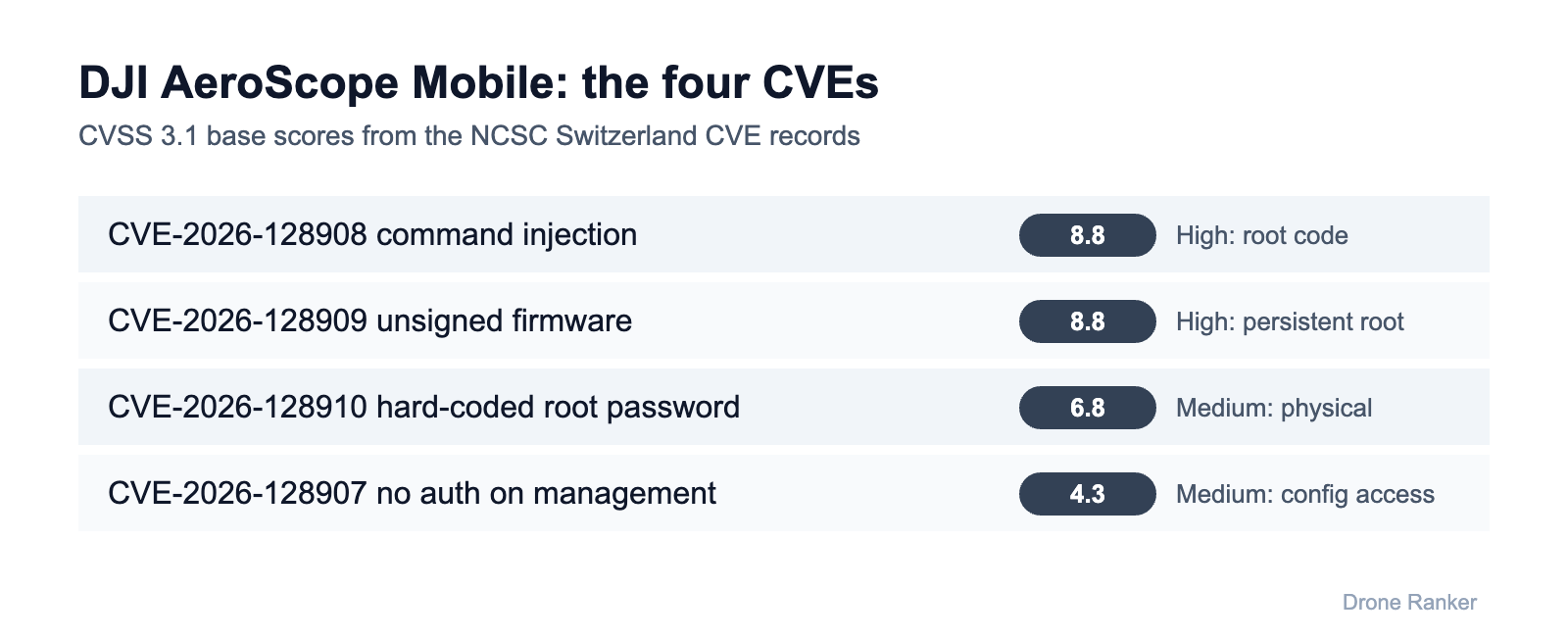
CVE-2026-128908, OS command injection (CVSS 8.8, High). Network settings are passed unquoted into shell commands on the communications board, so anyone who can reach its management service on TCP port 16000 can run commands as root without logging in. The injected command survives a reboot.
CVE-2026-128909, unsigned firmware updates (CVSS 8.8, High). The device accepts any firmware image that matches an MD5 checksum sent in the same request, with no signature check. That allows modified firmware and persistent root access. The researchers reproduced this one by running the device’s own software in emulation rather than on a physical unit.
CVE-2026-128910, hard-coded root password (CVSS 6.8, Medium). Every unit shares the same root password hash on its serial console, and it can be recovered from the firmware. This one needs physical access to the board.
CVE-2026-128907, no authentication on the management interface (CVSS 4.3, Medium). The same TCP 16000 service lets anyone nearby read the serial number, MAC address, IP and radio settings, and change configuration values.
How serious is this DJI AeroScope vulnerability set?
The high scores assume an attacker on the same local network as the device. The NCSC notes that if the management interface is reachable over a routed IP network, the two worst flaws would score 9.8, which is critical. In both cases the attacker needs no password and no user interaction.
For a drone-detection tool, the DJI AeroScope vulnerability risk is less about the hardware and more about trust. A compromised AeroScope unit could hide drones, show false ones, or leak the data it collects. That matters to the security teams that bought it, not to people who fly DJI drones.
DJI AeroScope vulnerability disclosure timeline
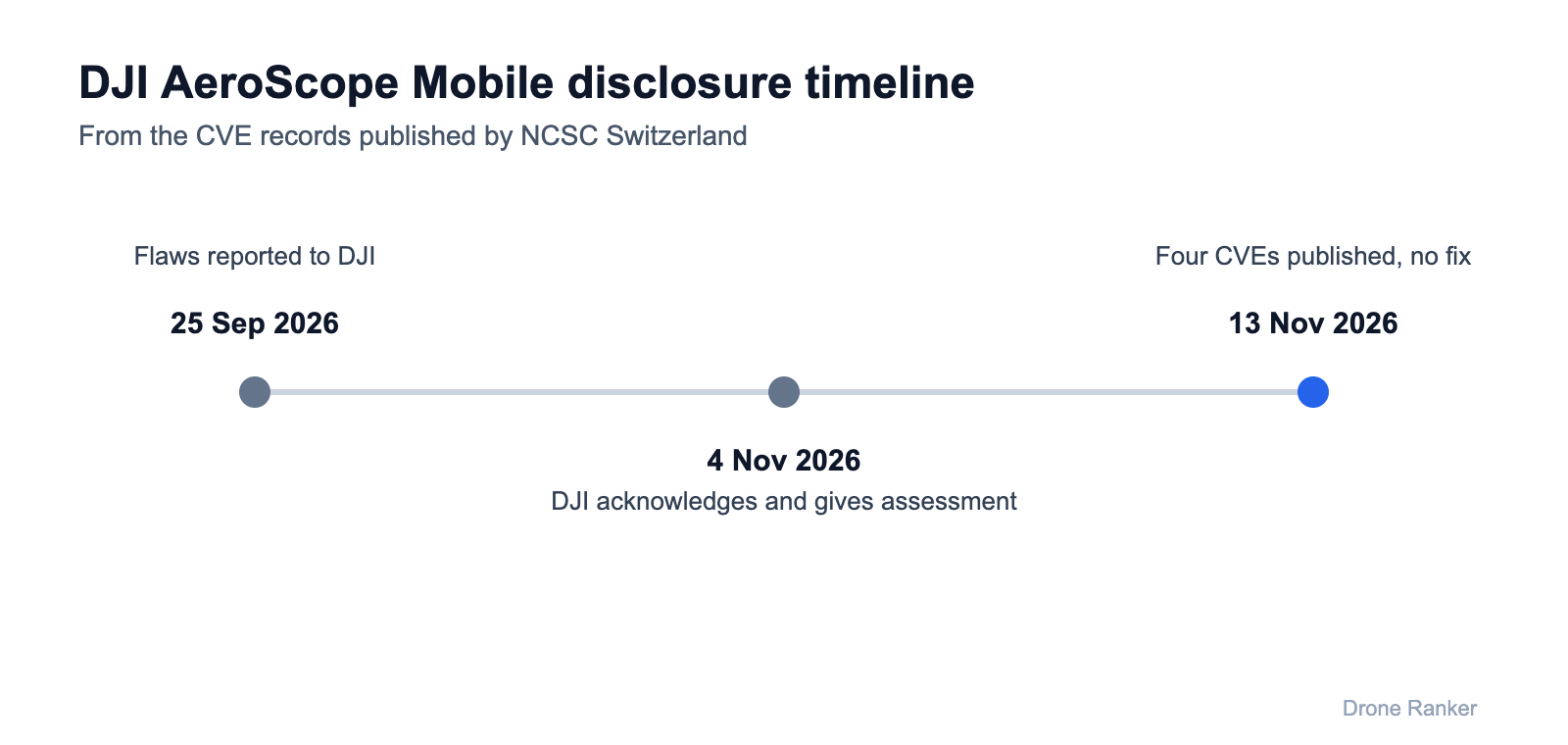
According to the CVE records, the issues were reported to DJI on 25 September 2026. DJI acknowledged them and gave its assessment on 4 November, and the four CVEs were published on 13 November. No fixed firmware is available, and the records say the shared root credential cannot be contained unit by unit.
What AeroScope Mobile owners should do
The only mitigation for this DJI AeroScope vulnerability set in the records is to keep the management Ethernet port isolated and off any routed network. Owners should also control physical access to the units and plan to replace them, since DJI is not shipping fixes for a product it no longer supports.
Does this affect DJI drone pilots?
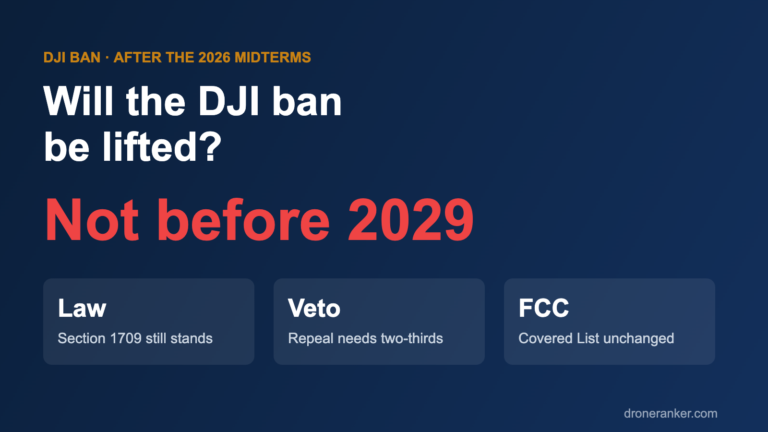
No. This DJI AeroScope vulnerability set and its four flaws are in the AeroScope Mobile detection unit, not in DJI drones, controllers or the DJI Fly app. Pilots do not need to do anything. If you are tracking DJI security more broadly, our report on the DJI Bluetooth vulnerability across 16 models covers a flaw that did affect the aircraft, and our explainer on whether the DJI ban will be lifted explains why security findings like this keep coming up in Washington.
The Friday Brief
One email a week on what changed in drones
FCC and FAA rule changes, DJI leaks checked against filings, and the week’s new comparisons. Every Friday, nothing else.
Free. Unsubscribe in one click. Sent with Kit; see our privacy policy.
Follow us on Google too: add Drone Ranker as a preferred source →
Continue Reading
All News