DJI EV50: DJI’s First eVTOL Drone Flies Research on Everest

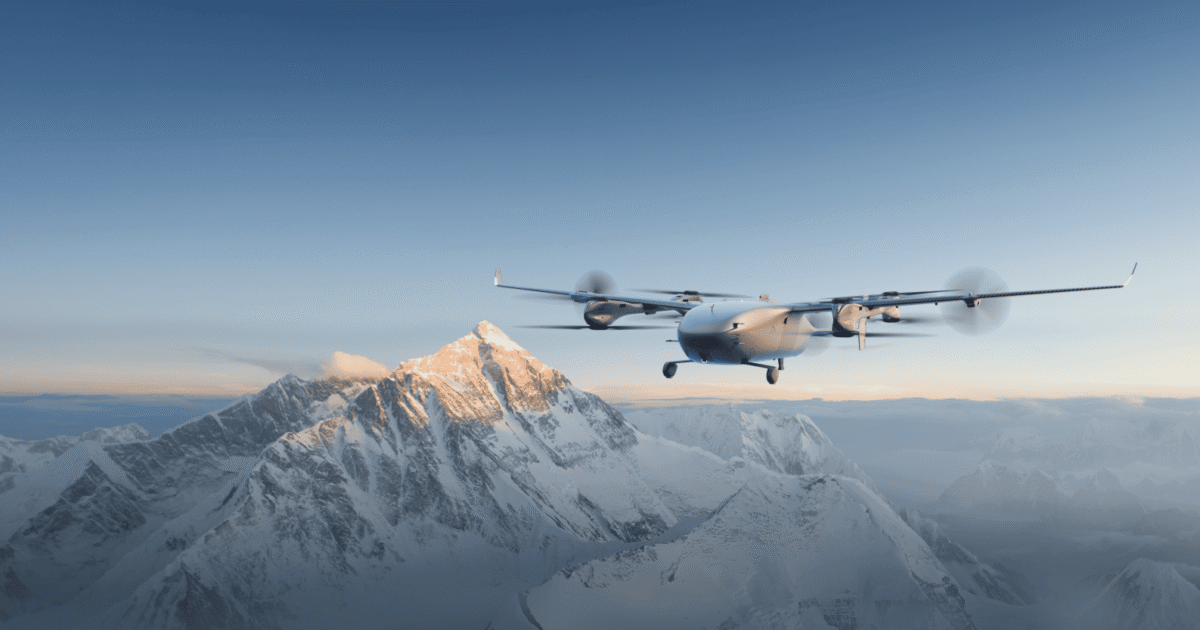
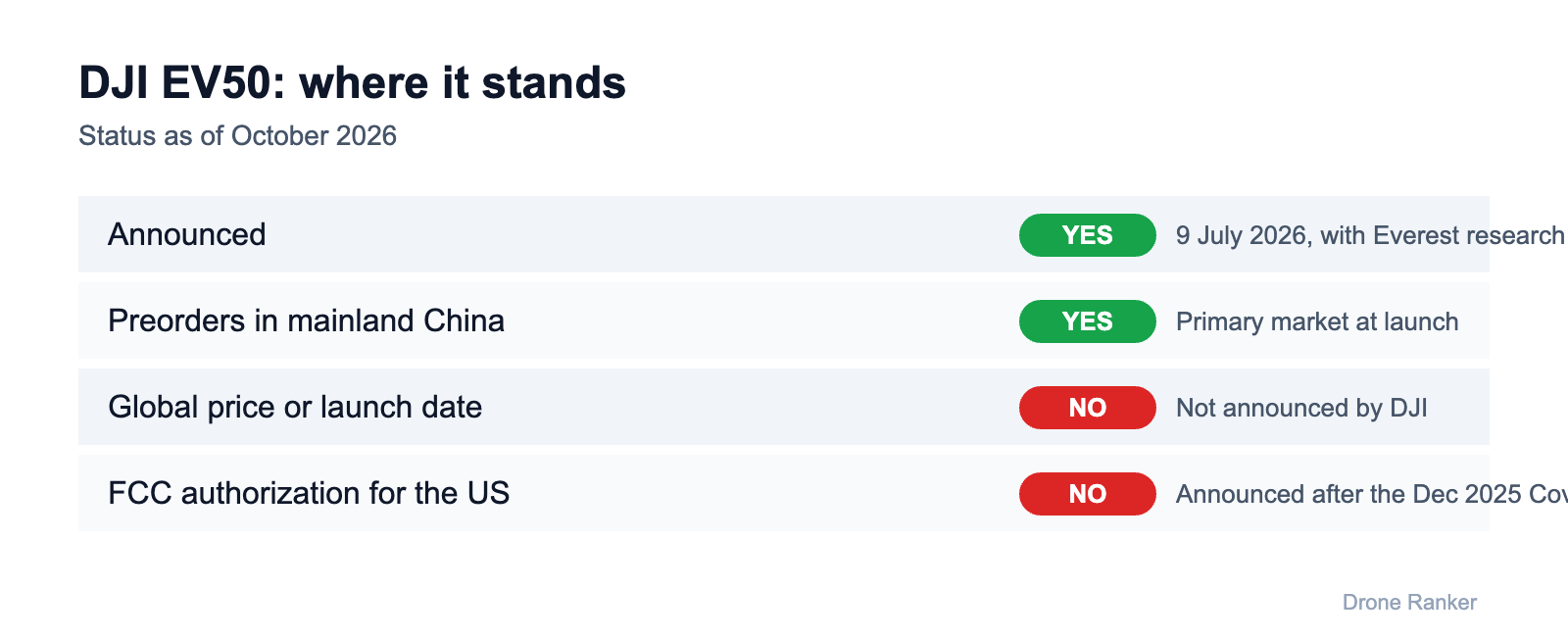
The DJI EV50 is DJI’s first electric vertical takeoff and landing (eVTOL) delivery drone. DJI announced it on 9 July 2026 and said it had supported atmospheric research on the North Slope of Mount Qomolangma (Everest). It is available for preorder mainly in mainland China, with no date or pricing yet for other markets.
The EV50 is a hybrid. It takes off and lands vertically on rotors, then flies forward on a fixed wing for efficiency. That lets it work where there are no runways while keeping the range needed for long-distance transport. According to DJI’s press release, it flew as part of a wider Everest mission alongside the FlyCart 100 and the Matrice 4E.
Table of Contents
What the DJI EV50 did on Everest
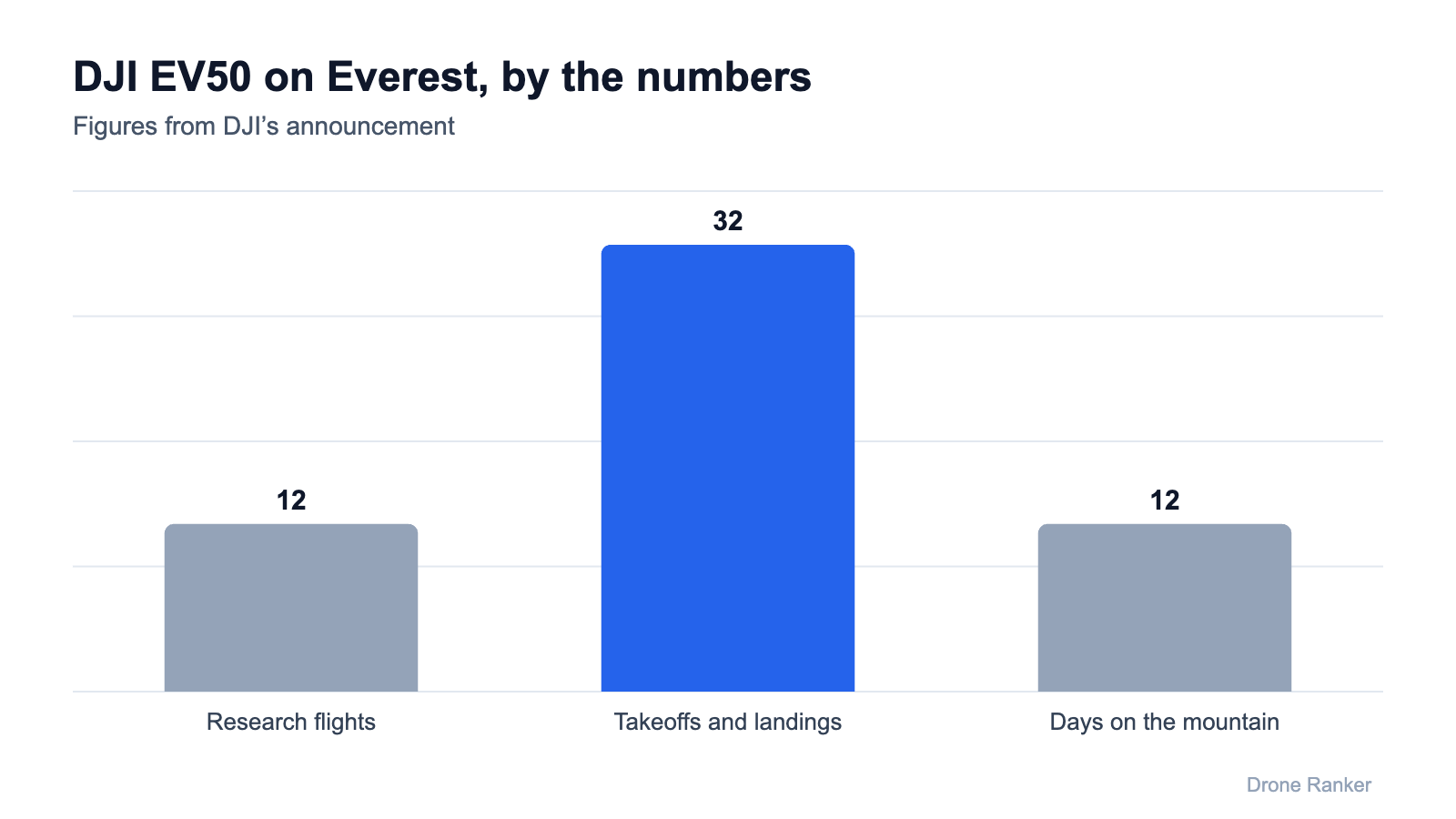
DJI says the EV50 flew 12 research flights over 12 days, with 32 takeoffs and landings in total, to help Peking University’s College of Environmental Sciences and Engineering measure pollutants in the ultra-high-altitude troposphere. It reached a maximum altitude of 8,861 meters, slightly above the summit itself, and made a continuous climb of 3,730 meters. DJI says the flights proved its stability in “complex winds and harsh flying conditions.”
Being fully electric matters for this kind of work: there is no exhaust to contaminate the air samples, as there would be with a helicopter. And unlike a weather balloon, which goes where the wind takes it, the EV50 can fly spiral ascents and back-and-forth patterns to build a vertical profile of the atmosphere at chosen coordinates.
| Feature | Specification |
|---|---|
| Type | Electric vertical takeoff and landing (eVTOL) |
| Maximum payload | 50 kg (about 110 lb) |
| Cargo volume | 270 liters |
| Maximum range (no load) | 150 km |
| Highest test altitude | 8,861 m |
| Propulsion | Fully electric |
Built for cargo
A 270-liter hold and a 50 kg payload put the EV50 in the heavy-lift class, between small delivery drones and cargo helicopters. Commercially, that space could carry medical supplies, tools for offshore sites or, as on Everest, scientific instruments.
It does a different job from the FlyCart 100. On the South Slope, DJI says, the FlyCart 100 moved 10 metric tons of supplies over shorter distances; the EV50’s North Slope work was about range and altitude. If DJI’s 150 km no-load range holds up in service, the EV50 is the platform it is pitching for remote islands and mountain sites.
The Matrice 4E’s role was mapping. DJI says it mapped 3 km² of the Khumbu Icefall in 3.5 hours, using a laser range finder for precise terrain measurement and flagging hazards that help heavier drones plan safer routes. A small mapping drone that scouts landing zones ahead of a big cargo aircraft looks like the package DJI will sell to search-and-rescue teams and industrial buyers.
DJI spokesperson Christina Zhang framed the missions as making the highest peaks safer and cleaner, not just setting records. Nepal’s Zero Waste Initiative aims to remove large amounts of trash from the mountain by 2027, and drones like the FlyCart 100 and EV50 could take over loads that Sherpas now carry across the Khumbu Icefall, around 8 kg of trash per climber.
Why the DJI EV50 is unlikely to reach the US
There is a second barrier for American operators beyond aviation rules. Since 22 December 2025 the FCC’s Covered List has blocked new equipment authorizations for foreign-made drones, DJI included. A drone that did not hold FCC authorization before that date cannot be imported or marketed in the US, and the EV50 was announced seven months later. Unless the FCC grants an exemption, the US is not a market DJI can sell it in.
That leaves the EV50 relevant to US readers mainly as a signal. DJI is moving from small cargo drones into heavier, longer-range delivery aircraft, and the makers in our list of foreign drones the FCC has exempted will be measured against what DJI can now do elsewhere.
When can you get a DJI EV50?
Not soon outside China. As of the July announcement the EV50 is on preorder primarily in mainland China, and DJI has not given a global launch date or international pricing. DJI has usually launched enterprise products at home first.
Regulation is the bigger obstacle. In the US and EU, flying a 50 kg-payload drone over 150 km means beyond-visual-line-of-sight operations and specific certifications.
The Everest flights are a strong proof of concept for high-altitude science, but they say little yet about everyday logistics. Until DJI publishes pricing and the EV50 clears regulators outside China, it is a demonstration, not a product most operators can plan around. DJI’s official announcement has more on the FlyCart and Matrice updates.
Enterprise drones listed on Amazon US
Mapping-focused enterprise drone listed on Amazon US.
DJI Matrice 4TD
Thermal, wide and tele cameras; the dock-ready Matrice 4 variant, with RC Plus 2 Enterprise.
As an Amazon Associate, Drone Ranker earns from qualifying purchases. We do not quote prices because Amazon’s change by the hour.
The Friday Brief
One email a week on what changed in drones
FCC and FAA rule changes, DJI leaks checked against filings, and the week’s new comparisons. Every Friday, nothing else.
Free. Unsubscribe in one click. Sent with Kit; see our privacy policy.
Follow us on Google too: add Drone Ranker as a preferred source →
Continue Reading
All News