FCC Drone Spectrum Vote: 450 MHz Control Links and 24 GHz Drone Radar on 19 November

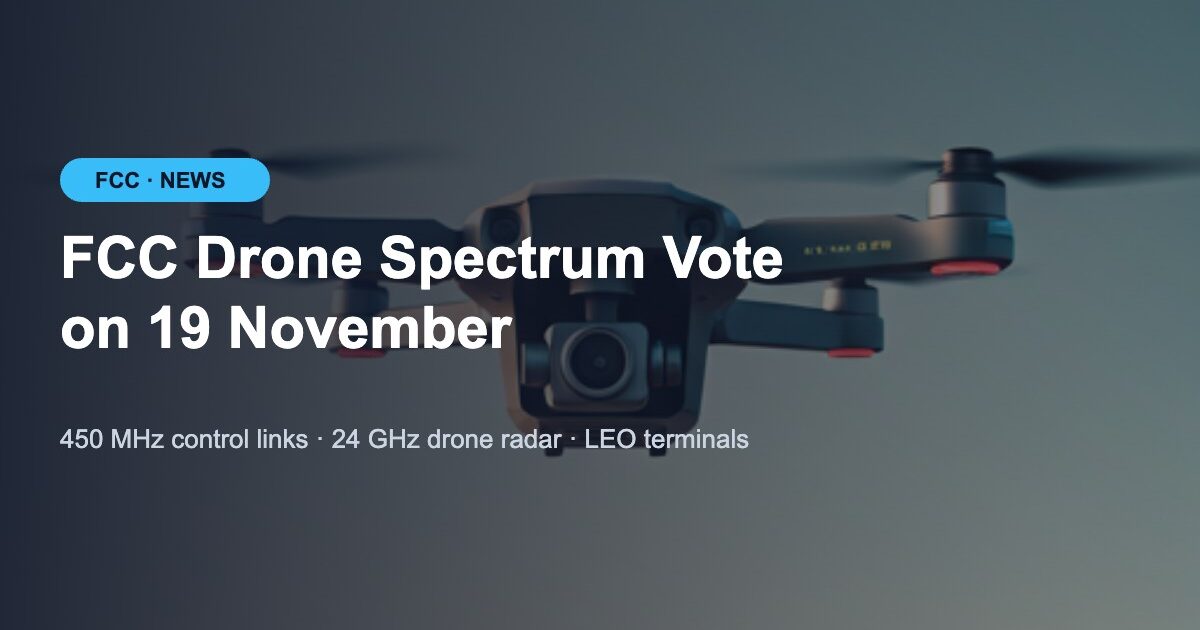
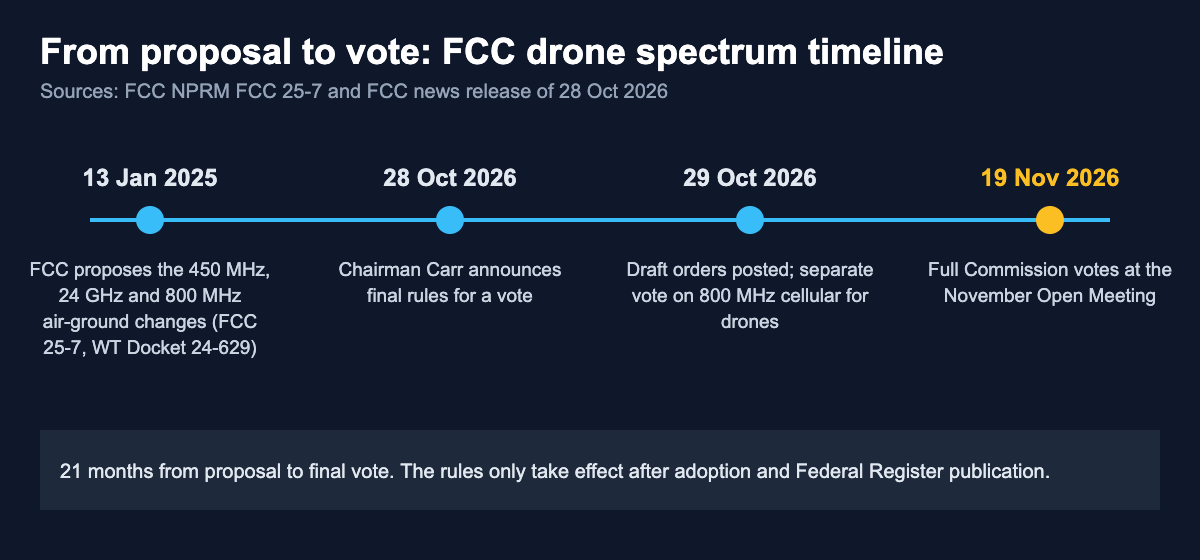
The FCC has put a second set of drone radio rules on its calendar. On 28 October Chairman Brendan Carr said the Commission will vote on 19 November on final FCC drone spectrum rules that would let drones use the 450 MHz band for control links, let ground radars hunt drones in the 24 GHz band and open more of the 28 GHz band to satellite terminals on moving vehicles, drones included. Carr’s announcement frames it as part of “American drone dominance”.
The timing is not an accident. The announcement came a day before the Commission’s 29 October vote on opening the 800 MHz cellular band to drones. That vote and this one are separate items, and none of it touches the 2.4 and 5.8 GHz links your DJI Mini or Air uses today.
Table of Contents
Four bands, two orders
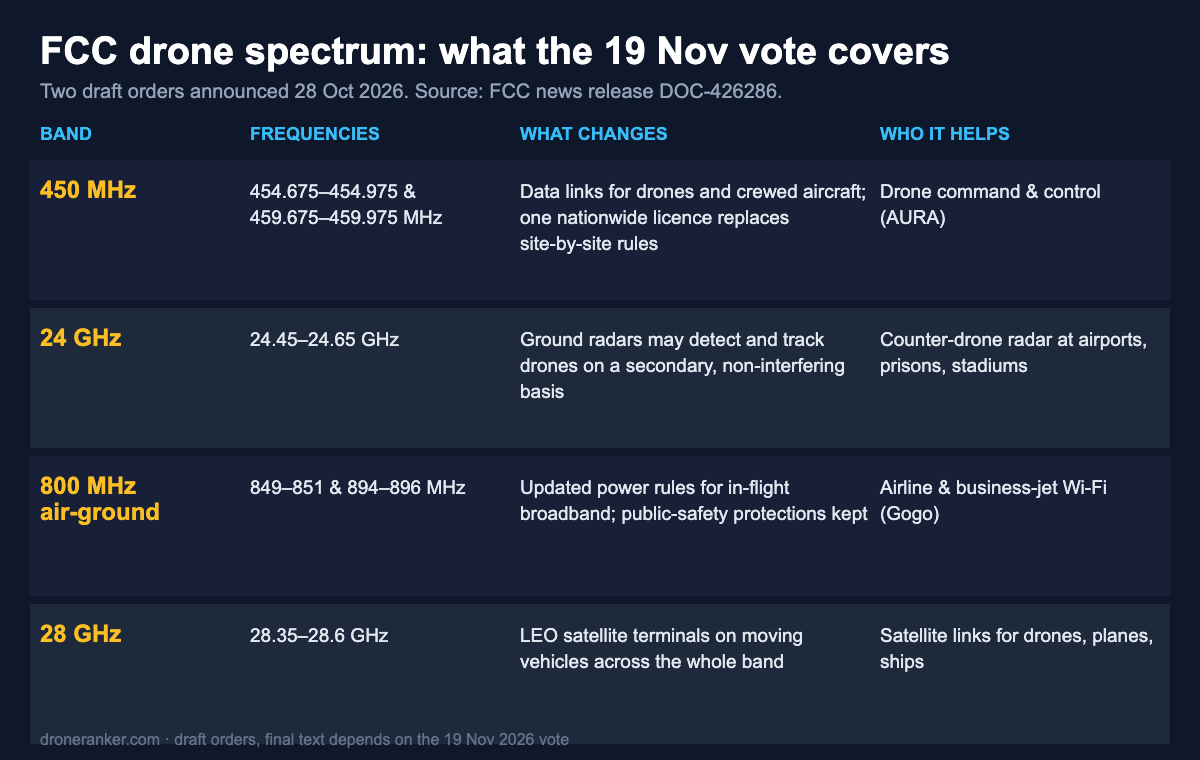
The FCC drone spectrum package is two draft orders. The first bundles three bands that the FCC proposed to change back in January 2025, under then-Chairwoman Jessica Rosenworcel. The second widens where satellite “earth stations in motion” can operate. The drafts go online at fcc.gov/November2026, and nothing is final until the five-member vote.
450 MHz: a nationwide link for drone control
The 450 MHz slice in question is small: 454.675–454.975 MHz paired with 459.675–459.975 MHz, according to the 2025 proposal (WT Docket 24-629). Today it serves an old air-ground telephone service. The FCC says the site-based rules limit it to voice calls for general aviation aircraft at high altitude, which in practice rules out the wide-area, low-altitude data service that drones need.
The final rules would open the band to safety-related data links between the ground and both crewed and uncrewed aircraft, and swap the site-by-site licences for a nationwide licensing system. That matters for command and control, the link that keeps a beyond-visual-line-of-sight drone under a pilot’s control when Wi-Fi-style radios run out of range.
There is one licensee to watch. DroneXL reports that AURA Network Systems is the band’s only incumbent and that the 2025 proposal would let it convert its regional licences into a single nationwide control-link licence without an auction. By DroneXL’s reading, the proposal ties that licence to coverage at 400 feet, with benchmarks at four and eight years. Whether those obligations survive into the final text is the detail to check when the draft posts.
24 GHz: radar that looks for drones
The second change gives counter-drone radar a home. Ground-based radars could use 24.45–24.65 GHz to detect and track unauthorized or dangerous drones near airports, borders, prisons, stadiums and critical infrastructure. They would run on a secondary basis and must not interfere with users that have priority in the band.
This is detection only. A radio licence does not give anyone the right to jam or take down a drone; that authority still sits with a short list of federal agencies, as we explain in who can take down a drone in the US. What changes is that airports and stadiums get a clearer legal path to install radar that sees small drones, which today often relies on case-by-case waivers.
In-flight Wi-Fi and satellite links
The third piece is about passengers, not pilots. The 800 MHz air-ground band (849–851 and 894–896 MHz) carries the ground-to-plane internet used on many business jets, a service DroneXL notes Gogo Business Aviation has run alone since 2013. The new power rules aim at better onboard broadband while keeping protections for public-safety radio next door.
The second order opens the full 28.35–28.6 GHz band to low-Earth-orbit satellite terminals on moving vehicles. The FCC’s own list of who benefits includes ships, planes, drones, blimps and cars. For large commercial drones, that is another route to a link that does not depend on a nearby tower.
What it means if you fly a consumer drone
For a DJI Mini, Air or Neo owner, almost nothing. Consumer drones talk to their controllers on unlicensed 2.4 and 5.8 GHz channels, and the November rules do not touch those. They also do not change the FCC Covered List or the status of foreign drones; that fight runs through the FCC’s drone exemptions and DJI’s Covered List dispute.
The effects are indirect. Licensed control links are what delivery and inspection operators need to fly long routes beyond line of sight, so the 450 MHz and 800 MHz changes push the market toward more of those flights over US towns. And as drone-detecting radar spreads around stadiums and prisons, a hobby flight in the wrong place becomes easier to spot.
What to watch on 19 November
Three things will tell you how big this is: whether the AURA licence keeps firm low-altitude coverage duties, whether the 24 GHz radar rules carry any new limits from the aviation users that share the band, and whether any commissioner dissents. We will update this page with the outcome on the day of the vote.
The Friday Brief
One email a week on what changed in drones
FCC and FAA rule changes, DJI leaks checked against filings, and the week’s new comparisons. Every Friday, nothing else.
Free. Unsubscribe in one click. Sent with Kit; see our privacy policy.
Follow us on Google too: add Drone Ranker as a preferred source →
Continue Reading
All News