DJI SDR Transmission 2: Upgrades, Hong Kong Price and Release

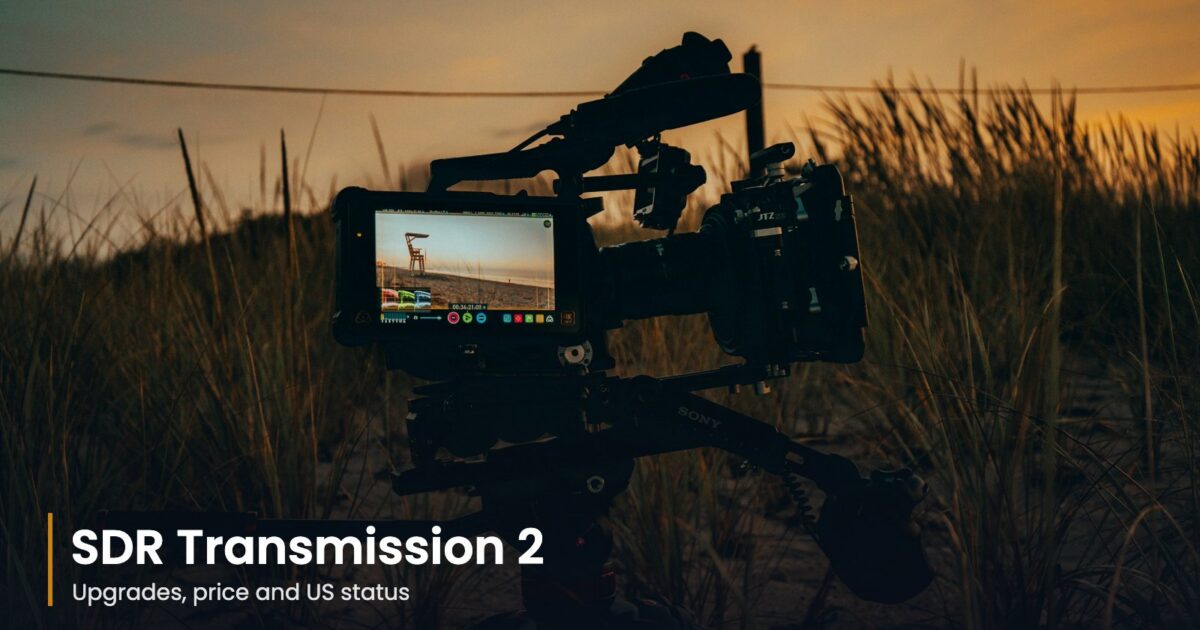
DJI SDR Transmission 2 is DJI’s new compact wireless video system for film crews, live production teams and Ronin users. Over the original it adds DCI 4K/60fps 10-bit HDR, a 50 Mbps maximum bitrate, up to 4 km of rated range, and a transceiver that can work as either transmitter or receiver.
Update, 22 October 2026: after its IBC debut, DJI priced SDR Transmission 2 on 17 September at €349 in Europe. It has not launched in the US; see what DJI you can still buy in the US.
DJI showed it at IBC 2026 in Amsterdam from September 11 to 14 and says full details and global availability will be announced on September 17. DJI’s Hong Kong store has already published prices and an unusually detailed spec list, which is where most of the figures below come from.
| Specification | DJI SDR Transmission 2 |
|---|---|
| Maximum video format | DCI 4K/60fps, 10-bit HDR |
| Codec and maximum bitrate | H.265, up to 50 Mbps |
| Rated transmission distance | Up to 4 km under DJI’s CE test conditions |
| Minimum stated latency | 35 ms, excluding camera and display latency |
| Network size | 1 TX to 8 controllable RX units; up to 5 TX and 40 RX in one area |
| Main-unit weight | Approximately 136 g including antennas |
| Power options | NP-F battery, USB-C PD, or compatible gimbal power |
| Hong Kong list price | HKD 2,399 for one transceiver; HKD 4,099 for the combo |
Table of Contents
SDR Transmission 2: one box that can transmit or receive
The original system used fixed transmitter and receiver roles. The new one uses a switchable transceiver, so each main unit can be set as TX or RX. On a shoot where the monitoring plan changes during the day, that is the most useful change here. A small interview might need one camera feed and two monitors; a later multi-camera scene needs more transmitters and fewer receivers. With switchable units, the case is less likely to hold the wrong mix.
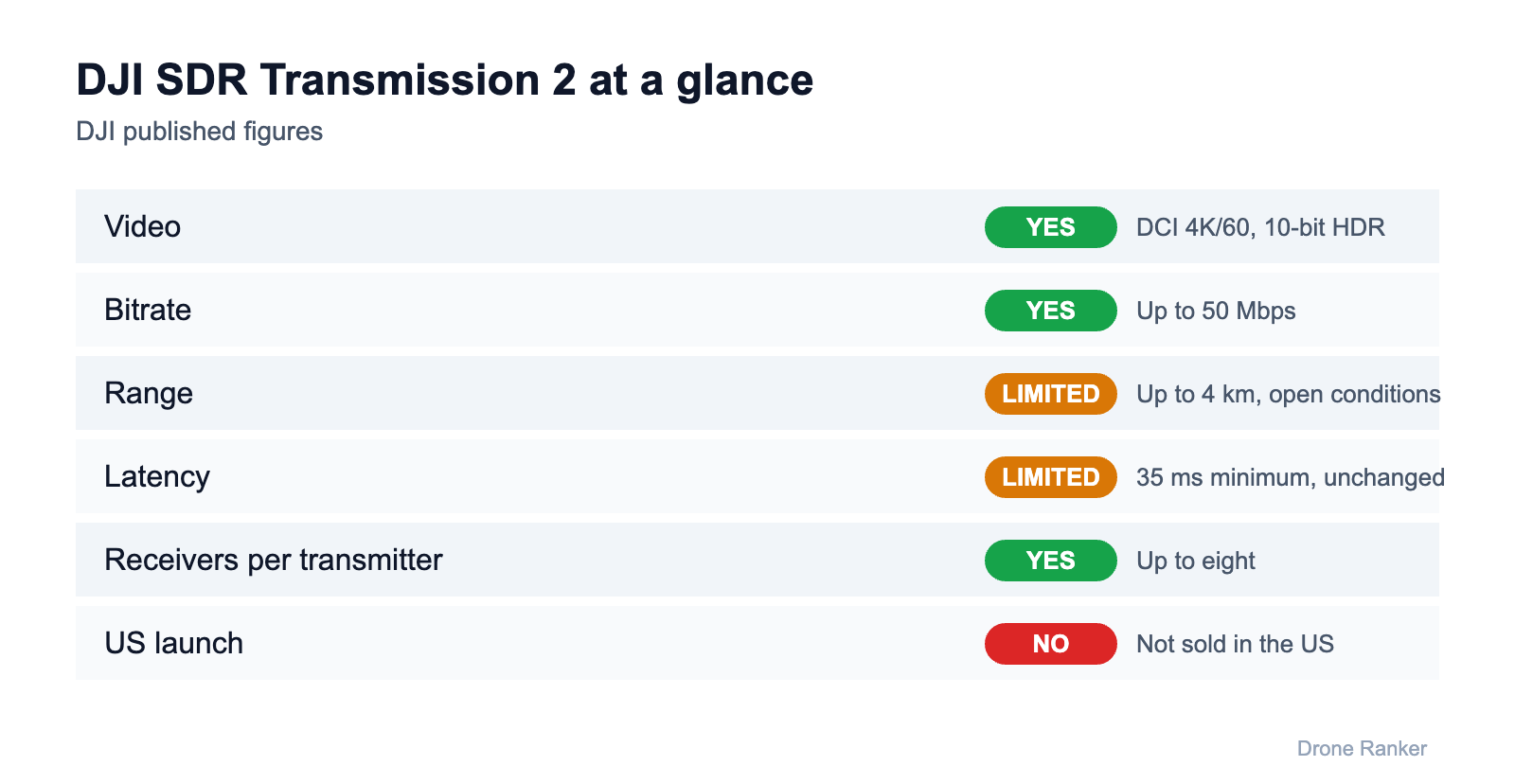
One transmitter can feed up to eight receivers, and DJI says every receiver can keep remote-control capability. DJI also lists up to five transmitters and 40 receivers running in the same area, though it recommends no more than five transmitters for the best experience.
DJI SDR Transmission 2: DCI 4K/60 HDR at 50 Mbps
The headline upgrade is DCI 4K at 60fps with 10-bit HDR, encoded in H.265 at up to 50 Mbps, against 20 Mbps on the previous model.
That does not mean every camera and monitor will show 4K HDR. DJI’s footnotes say it requires an HDMI or DisplayPort connection on the main transceiver, and the display, cabling, camera output and chosen signal format are all still part of the chain. For a director, focus puller or client monitor, the gain is a better reference feed for judging exposure, color and detail. It is still a compressed wireless image, not the camera’s recording.
SDR Transmission 2 range: 4 km on paper
DJI rates the link at up to 4 km in an open, unobstructed, interference-free environment under CE conditions, up from a 3 km comparison figure for the original. Don’t read that as a promise for a convention hall, city street, stadium or metal-heavy studio. Walls, other wireless systems, antenna position, channel restrictions and line of sight all cut real range. On most sets the benefit is more margin at normal working distances, for example when the camera moves behind vehicles or through a building.
Auto Channel 2.0
With Channel Mode set to Auto, nearby transceivers recognize each other, scan the spectrum, diagnose conflicts and move channels as conditions change. DJI pitches this as a major stability gain for productions running several systems side by side. Crews can still pick a channel manually on the unit or in the DJI Ronin app.
DJI warns that a 2.4 GHz channel may interfere with other wireless gear, including wireless microphones, and recommends choosing a non-2.4 GHz option where local rules allow. Some 5.8 GHz and DFS bands are unavailable in certain countries, so the channel list differs by market.
Latency is unchanged at 35 ms
DJI quotes a minimum latency of 35 ms, measured with 1080p/60 and 4K/60 signals, the same as before. That figure excludes the camera and the display. End-to-end delay adds camera processing, encoding, receiver output and monitor processing, so a slow camera output or a TV-style display with heavy processing will show more lag. For focus pulling or precise gimbal moves, test the exact camera, cable, format and monitor you will use on set.
Ports, monitoring and Ronin control
The transceiver has one HDMI port and two USB-C ports, one of which can carry DisplayPort video. SDI needs the separate expansion plate, which adds SDI and HDMI connections.
A receiver can feed a smartphone or tablet over USB-C (or, on supported Apple devices, a suitable Lightning cable, not included) for a stable wired view in the Ronin app. You can switch between camera feeds from the transceiver or the app.
DJI lists compatibility with RS 5, RS 4 Pro, RS 4, RS 3 Pro, Ronin 2 and Master Wheels. Depending on gimbal and camera, crews can move and recenter the gimbal, start or stop recording and adjust supported camera settings. Several of those functions need extra cables: RS 4 Pro, RS 4 and RS 3 Pro use a separately sold USB-C-to-CAN cable, Ronin 2 and Master Wheels need a USB-C-to-4-pin cable, and camera control depends on a compatible multi-camera control cable and the camera model.
One limitation is easy to miss: DJI’s FAQ says the system does not support Focus Pro, even though both belong to the Ronin family.
Weight and power
The main unit weighs about 136 g with antennas, slightly less than the 145 g transmitter and receiver of the previous generation, which helps on a handheld gimbal or compact cage. Power comes from an NP-F battery, USB-C Power Delivery or a compatible gimbal. The single-unit package includes an NP-F adapter, but no NP-F battery is listed.
It also connects to Osmo Action 6 and Osmo Pocket 4 or later over USB-C for monitoring and power, a lighter option for sports, vehicle or odd-angle shots where a cinema camera would be overkill.
New versus original
| Feature | DJI SDR Transmission 2 | Original DJI SDR Transmission |
|---|---|---|
| Hardware roles | Switchable TX/RX transceiver | Fixed transmitter and receiver |
| Maximum video format | DCI 4K/60fps, 10-bit HDR | Lower maximum format; HDR not supported in DJI’s comparison |
| Maximum bitrate | 50 Mbps | 20 Mbps |
| Rated range | Up to 4 km in DJI’s CE test | 3 km comparison figure |
| Minimum stated latency | 35 ms | 35 ms |
| Main-unit weight | About 136 g | About 145 g per TX or RX |
| Network design | 1 TX to 8 controllable RX; multi-group | Broadcast mode with unlimited RX, fixed roles |
Price, and the US question
DJI’s Hong Kong store lists:
- DJI SDR Transmission 2: HKD 2,399 for one transceiver with mounting and power accessories
- Combo: HKD 4,099
- Expansion Accessory Kit: HKD 1,159, listed out of stock when checked
These are not US, UK or European prices, and currency conversion won’t predict them, because taxes, distribution, warranty and availability differ by market. I’d wait for the official regional store page rather than import on the strength of the early listing.
US availability is the biggest open question. DJI showed the product in Europe and has a live Hong Kong page, but there is no US price in those materials. DJI’s products face new FCC authorization restrictions in the US, and new tariffs can raise the cost of imported drone-related gear. A video transmitter is not treated the same as an aircraft, so wait for a product-specific US statement. Our DJI US availability guide explains the equipment-authorization problem, and our 2026 drone tariff analysis covers customs costs.
Who should buy it
The clearest buyers are small and medium crews that already use DJI RS gimbals, need more than one controllable receiver, or keep changing camera and monitor layouts: documentary, commercial, live-event, vehicle-rig and multi-camera teams. For them I think this is a real upgrade, not a cosmetic refresh. Owners who mostly run one 1080p feed at short range will get much less from it.
Solo creators should price the whole kit. One transceiver is not a complete wireless link, since you need a unit at each end, SDI needs the expansion plate, and some gimbal control needs extra cables.
If you already own the original, start from your actual bottleneck. If it’s monitor delay, test total latency, because the stated figure hasn’t changed. If it’s radio congestion, Auto Channel 2.0 may matter more than 4K. If it’s weight, the 136 g unit helps, but the battery and mounting hardware still count.
DJI drones still sold in the US
DJI Mini 4 Pro (RC-N2)
Under 249 g, omnidirectional sensing without LiDAR, still in DJI’s US line-up.
151 g, 4K/60 and omnidirectional sensing. The current Neo you can buy in the US.
DJI Air 3S (RC-N3)
1-inch main camera plus a 70 mm tele, up to 45 min. One of the models the FCC LiDAR proposal could reach.
As an Amazon Associate, Drone Ranker earns from qualifying purchases. We do not quote prices because Amazon’s change by the hour.
The Friday Brief
One email a week on what changed in drones
FCC and FAA rule changes, DJI leaks checked against filings, and the week’s new comparisons. Every Friday, nothing else.
Free. Unsubscribe in one click. Sent with Kit; see our privacy policy.
Follow us on Google too: add Drone Ranker as a preferred source →
Continue Reading
All News