Best Drones of 2026: 9 Picks Worth Buying This November

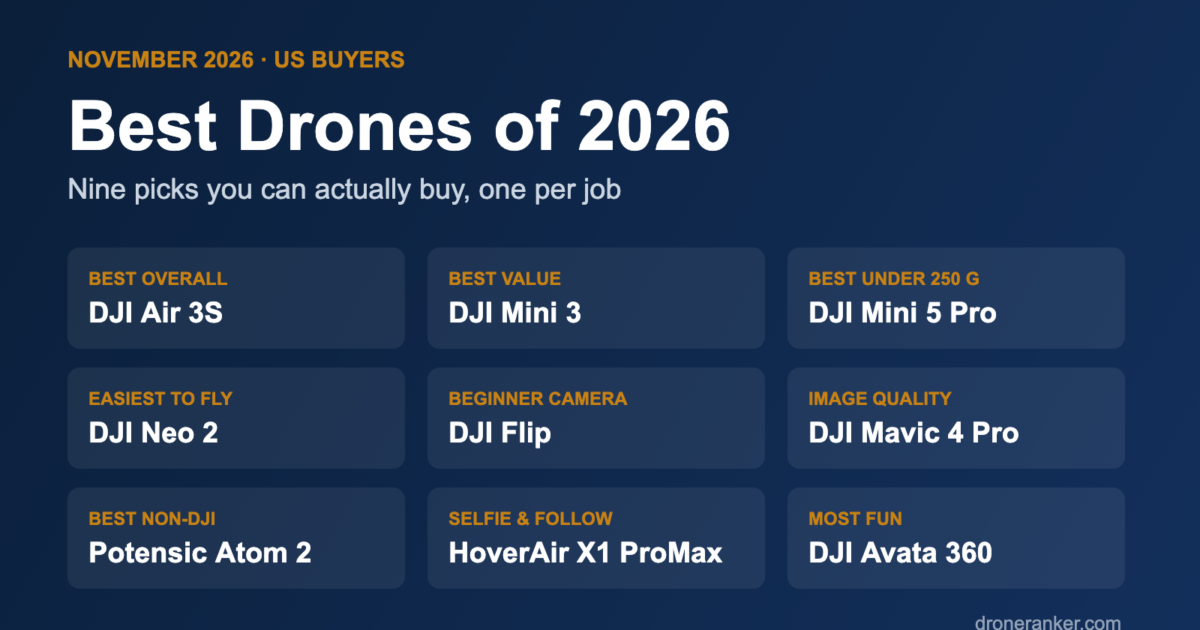
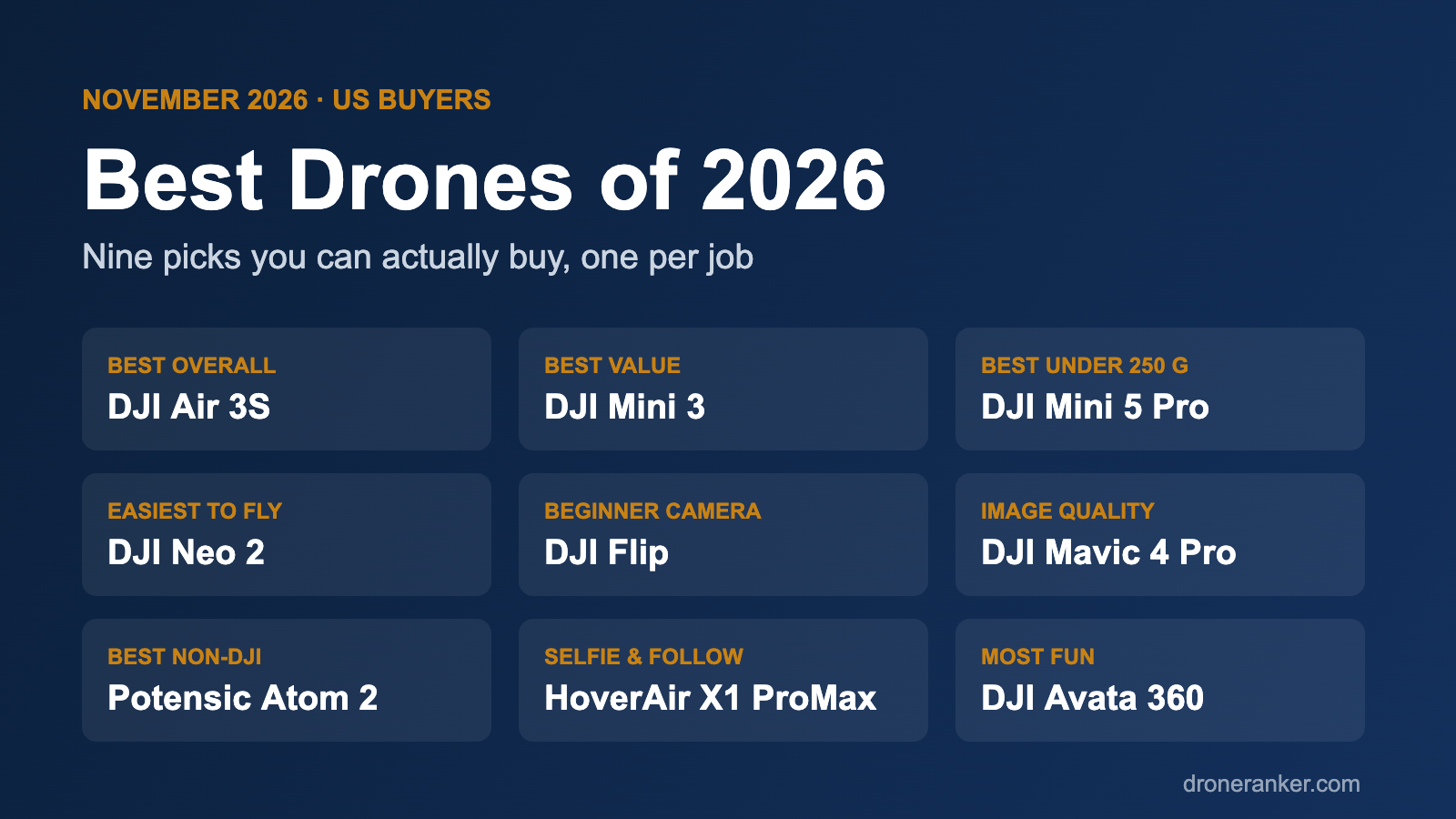
The best drones 2026 has to offer are not the newest ones. If you live in the US, the drone you can actually buy this November is the one the FCC approved before its December 2025 cutoff, and that changes the list more than any spec sheet. My pick for most people is the DJI Air 3S. If you want to spend under $300, get the DJI Mini 3. If you want something that is not a DJI, the Potensic Atom 2 is the one I would buy.
Below are nine drones, one per job, from a 151 g selfie drone to a 1 kg three-camera Mavic. I ranked these best drones 2026 picks on published specifications, FCC status and recent US prices. Drone Ranker did not flight-test these aircraft, and I say so where it matters.
What is in this guide
The nine picks at a glance
| Drone | Best for | Weight | Camera | Flight time | Recent US price |
|---|---|---|---|---|---|
| DJI Air 3S | Best overall | 724 g | 1-inch wide + 70 mm tele | 45 min | $1,099 at launch |
| DJI Mini 3 | Best value | Under 249 g | 1/1.3-inch, 4K/30 HDR | 38 min | $269 (Prime sale, Oct) |
| DJI Mini 5 Pro | Best under 250 g | 249.9 g | 1-inch, 4K/120 | 36 min | $759 at launch |
| DJI Neo 2 | Easiest to fly | 151 g | 12 MP, 4K/60 | 19 min | About $259 (bundle, 1 Nov) |
| DJI Flip | Best beginner camera drone | 249 g | 1/1.3-inch 48 MP, 4K/60 HDR | 31 min | $439 at launch |
| DJI Mavic 4 Pro | Best image quality | 1,063 g | 4/3 100 MP + two tele cameras | 51 min | $2,699 Fly More (1 Nov) |
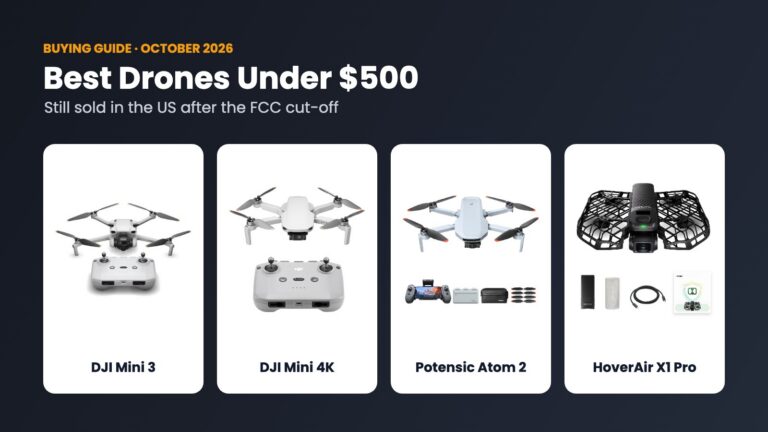
| Potensic Atom 2 | Best non-DJI drone | Under 249 g | 1/2-inch, 4K/30 HDR | 32 min | About $210 on sale |
| HoverAir X1 ProMax | Best for selfies and follow shots | 192.5 g | 1/1.3-inch, 8K/30 | 16 min | Check current price |
| DJI Avata 360 | Most fun | About 455 g | Two 1/1.1-inch, 8K/60 360° | 23 min | $719 with RC 2 |
Why the 2026 list looks different
Any list of the best drones 2026 buyers can trust starts with one date. On 22 December 2025 the FCC stopped authorizing new foreign-made drones, which put DJI and most of its rivals on the Covered List. Models that were approved before that date can still be sold. Models that came later cannot get an FCC ID, so they either never reach US shelves or show up only through third-party sellers with no official US support.
That is why a 2022 drone like the Mini 3 is still on this list and why the Potensic Atom 3, a better drone than the Atom 2 on paper, is not. It is also why I mark the picks that DJI’s own US store does not sell. Our Covered List exemptions explainer covers the rule in detail, and the DJI launch on 5 November is enterprise hardware that will not change this list.
DJI Air 3S: the one most people should buy
The Air 3S is the drone I would tell a friend to buy if they wanted one drone for the next five years. It pairs a 1-inch main camera with a 70 mm telephoto, and that second lens is what makes footage look planned rather than lucky: you can compress a mountain behind a cyclist or circle a lighthouse without flying close to it.
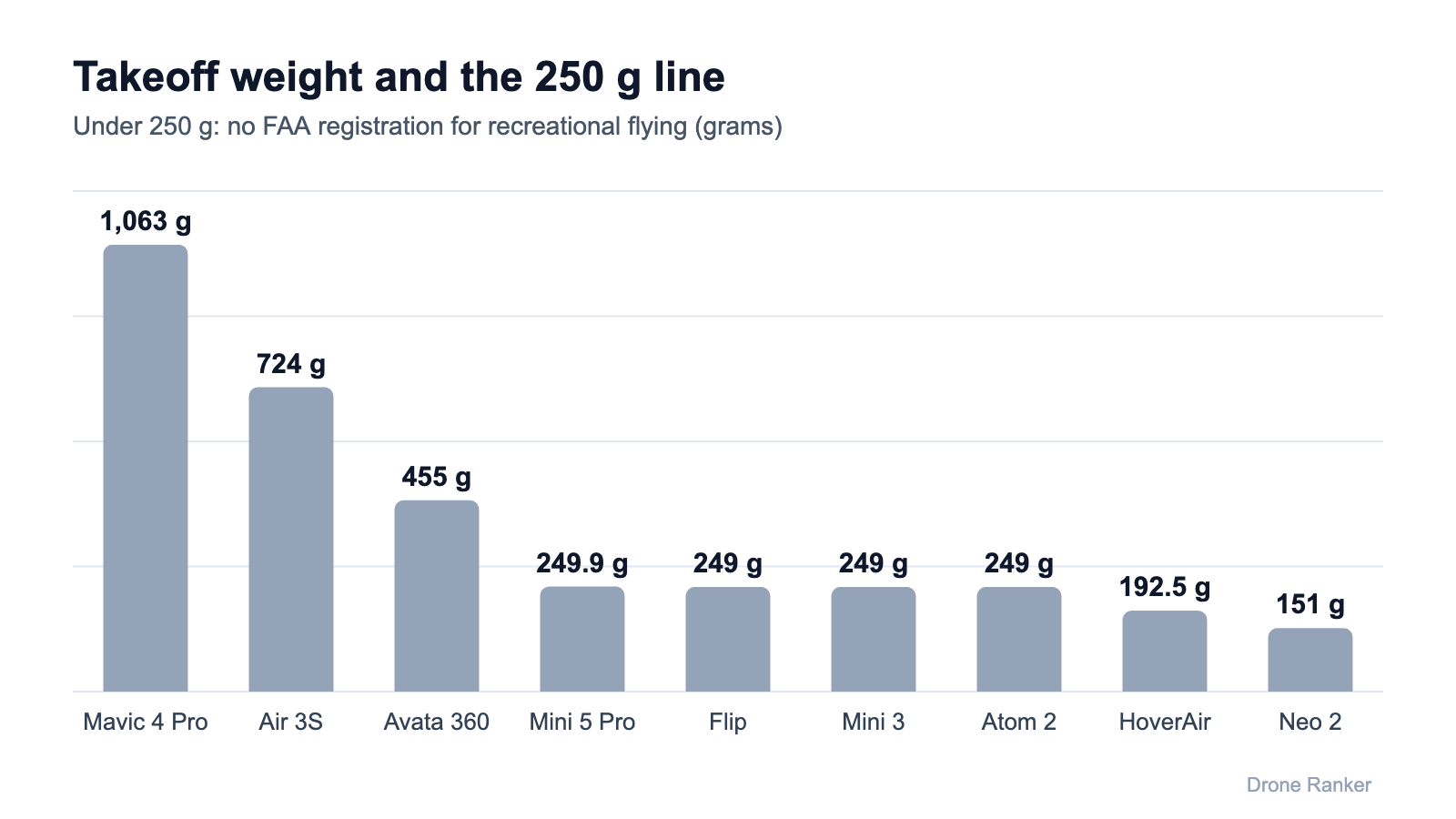
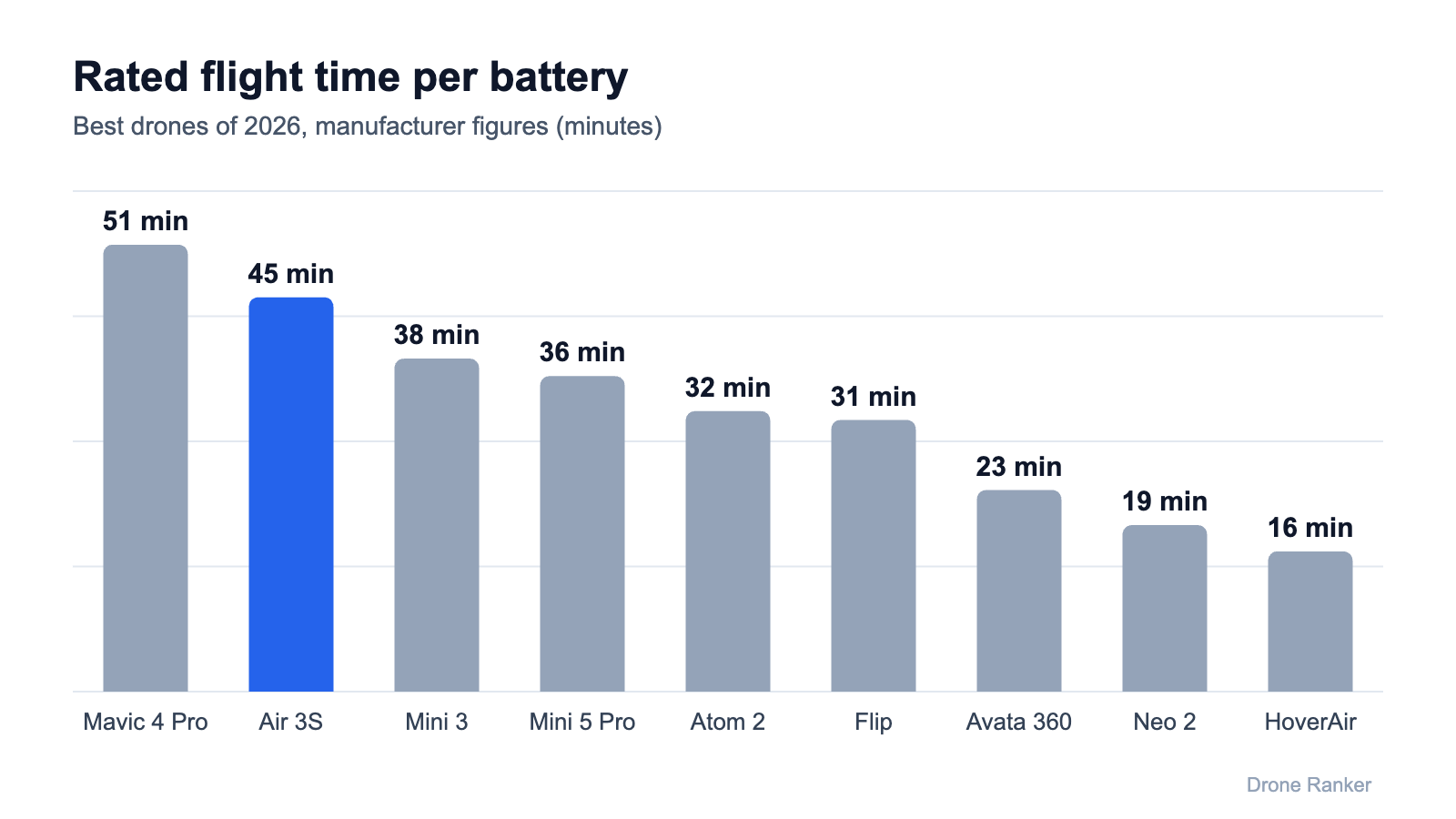
It also carries omnidirectional vision plus forward LiDAR for obstacle sensing at night, 42 GB of internal storage and a rated 45 minutes per battery. The catch is weight. At 724 g you must register it with the FAA and broadcast Remote ID, and it takes more space in a bag than a Mini. DJI’s US store still lists it, which matters for warranty and repairs.
DJI Mini 3: still the smartest money under $300
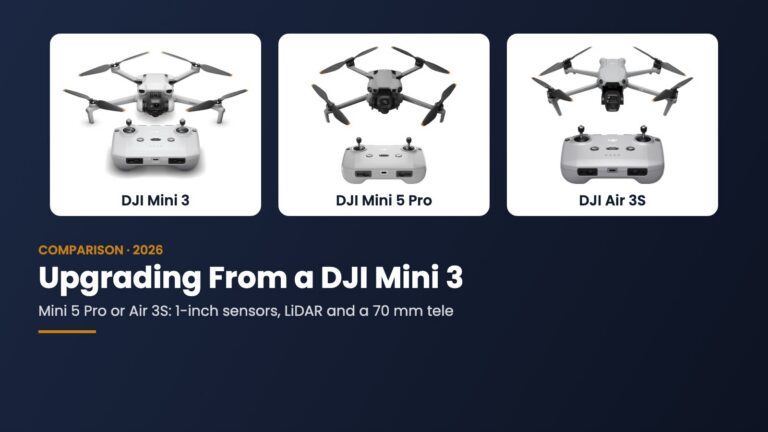
The Mini 3 is four years old and still the best value in the US. You get a 1/1.3-inch sensor, 4K HDR video, true vertical shooting and up to 38 minutes of flight, all under 249 g, so recreational pilots skip FAA registration. During Prime Big Deal Days in October it fell to $269.
What you give up is obstacle avoidance. The Mini 3 only sees downward, so you need to watch trees and wires yourself. If that worries you, the next pick up is the Neo 2 or Flip. Our best drones under $500 list goes deeper on budget options.
DJI Mini 5 Pro: the best camera under 250 grams, if you can find one
On paper the Mini 5 Pro is the most impressive drone here: a 1-inch, 50 MP sensor, 4K at 120 fps, omnidirectional sensing with forward LiDAR and 36 minutes per standard battery. It is the closest thing to an Air 3S that fits in a jacket pocket.
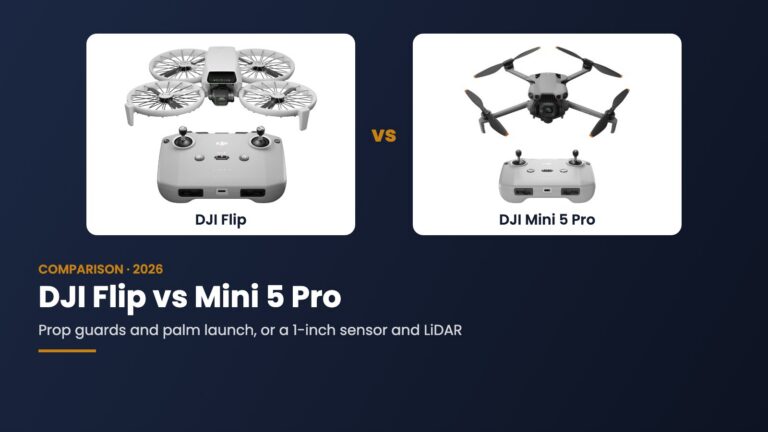
Two things hold it back in the US. DJI never launched it here officially, so it comes from third-party sellers with uncertain service. And at 249.9 g it sits right on the line: some owners have weighed units at 252 to 253 g, and the larger Plus battery pushes it clearly over, which means FAA registration either way. Read our Flip vs Mini 5 Pro comparison before you pay the premium.
DJI Neo 2: the easiest drone to fly
The Neo 2 is a 151 g drone that takes off from your palm, follows you and lands back in your hand. The upgrade that matters over the original Neo is omnidirectional obstacle sensing, which makes follow shots through a park much less stressful. It records 4K at 60 fps and flies for about 19 minutes.
It is a selfie and vlogging tool, not a landscape camera, and the short flight time means you want the Fly More bundle. Tom’s Guide listed that bundle at about $259 on 1 November. In the US it is sold through third-party sellers rather than DJI’s store.
DJI Flip: the beginner drone with a real camera
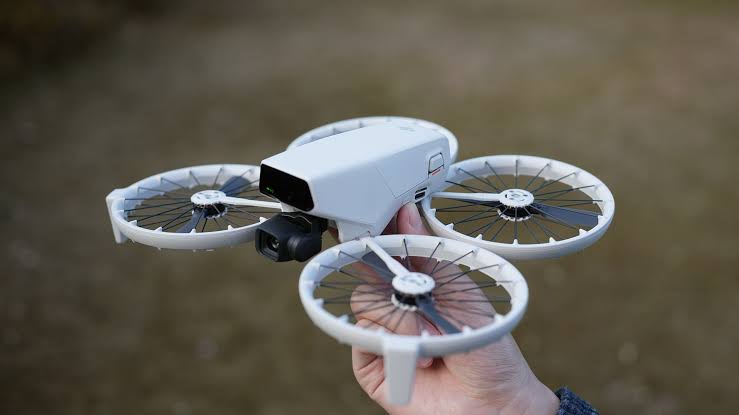
The Flip is what I would give someone who has never flown. Full propeller guards fold over the motors, so a bump into a wall is a non-event, and it still has a 3-axis gimbal, a 1/1.3-inch 48 MP sensor, 4K/60 HDR and a rated 31 minutes in a 249 g body.
It only senses obstacles forward and downward, and the guards make it bulkier than a Mini. Unlike the Mini 5 Pro, it is sold by DJI’s US store, which is a real advantage when something breaks.
DJI Mavic 4 Pro: when the footage pays the bills
If you sell your footage, the Mavic 4 Pro is the drone to buy. Its 4/3 Hasselblad camera shoots 100 MP stills with an adjustable aperture, and two telephoto cameras give you 28, 70 and 168 mm views from one flight. The rated 51 minutes per battery is the longest on this list. Our Mavic 4 Pro specs analysis breaks down the cameras.
At 1,063 g it is a serious aircraft with serious rules, and the Fly More kit was $2,699 on Amazon on 1 November, about $200 above its October low. It is only available through third-party sellers in the US. Most hobbyists will be happier with an Air 3S and the $1,600 difference.
Potensic Atom 2: the best drone that is not a DJI
The Atom 2 is the non-DJI drone I would actually buy. A 1/2-inch Sony sensor, 4K/30 HDR on a 3-axis gimbal, up to 32 minutes and Potensic’s 10 km PixSync transmission put it close to the Mini 3 for less money; it has sold for about $210 on sale. It is FCC-approved and easy to find.
It only senses downward, and the app and image processing are a step behind DJI. The newer Atom 3 is better but has no FCC authorization, as our Atom 3 review explains. More details are on Potensic’s site.
HoverAir X1 ProMax: a flying camera for people who hate controllers
The X1 ProMax is not a drone you pilot so much as a camera that follows you. At 192.5 g it folds smaller than a phone, records 8K/30 or 4K/120 from a 1/1.3-inch sensor and can track a cyclist at up to 42 km/h.
The trade-offs are short flights, about 16 minutes, and only a rear proximity sensor, so it relies on open space. It was approved before the FCC cutoff and is on US shelves. For the full lineup see HoverAir.
DJI Avata 360: the most fun you can have with 8K
The Avata 360 films everything around it at once with two 1/1.1-inch sensors at 8K/60, so you choose the framing later. Combined with goggles it is the most immersive drone here, and the ducted frame tolerates the bumps that come with low, fast flying.
It weighs about 455 g, flies for up to 23 minutes and launched at $719 with the RC 2. DJI says it is not officially sold in the US, so buy from a retailer you trust. If you want 360° from a brand with official US distribution, read our piece on Antigravity and the US market.
Where to buy the DJI picks
The DJI picks on Amazon
DJI Air 3S
Best overall. Dual camera, 45 minutes, sold by DJI US.
DJI Mini 3
Best value under 249 g. Watch for sale prices near $269.
DJI Mini 5 Pro
1-inch camera under 250 g. Third-party sellers only in the US.
DJI Neo 2
Palm launch and omnidirectional sensing. Get the Fly More bundle.
DJI Flip
Prop guards, gimbal, 31 minutes. Easiest real camera drone for beginners.
DJI Mavic 4 Pro
Three cameras and 51 minutes for paid work.
8K 360° FPV. Not sold by DJI in the US.
As an Amazon Associate, Drone Ranker earns from qualifying purchases. Prices on Amazon change often, so check the listing and the package contents before you buy. More picks are on our Amazon storefront.
How I picked these drones
To make this list of the best drones 2026 has produced, each drone had to be buyable in the US on 1 November 2026, either from the maker or from a major retailer, and approved by the FCC. I compared manufacturer specifications, checked FCC status, and used dated US prices from retailers and deal trackers. Where a price is a launch price, I say so. I left out drones that only make sense for professionals, such as enterprise thermal models; our best DJI drones guide covers those.
Should you wait for Black Friday?
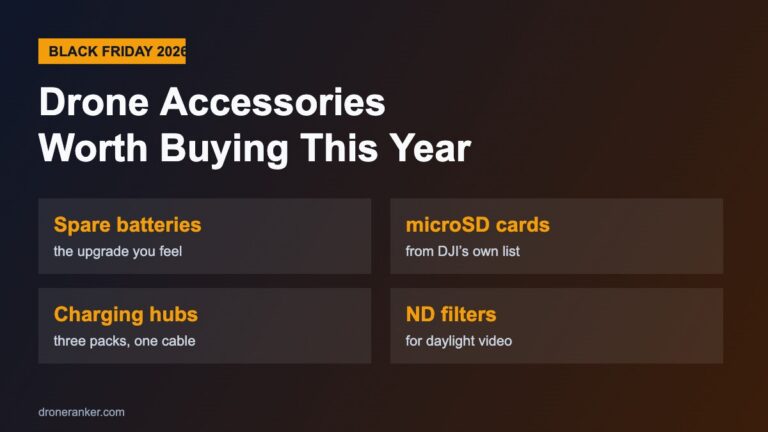
If you are not in a hurry, yes. Black Friday is 27 November, and that week is when the best drones 2026 has to offer usually see their deepest cuts. Early deals are already showing up. We track prices weekly on our DJI drone deals page, and our Black Friday drone accessories guide lists the spare batteries and cards worth adding.
Waiting for a new model makes less sense. The rumoured Mini 6 Pro and Neo 3 have no FCC filings, and under the current rules they may never be sold in the US. The best drones 2026 offers American buyers are the ones already on the shelf.
The Friday Brief
One email a week on what changed in drones
FCC and FAA rule changes, DJI leaks checked against filings, and the week’s new comparisons. Every Friday, nothing else.
Free. Unsubscribe in one click. Sent with Kit; see our privacy policy.
Follow us on Google too: add Drone Ranker as a preferred source →
Continue Reading
All News